

Most organisations that move to distributed domain ownership do so believing the hard part is behind them. It is not. The harder question is what they actually built.
For most of the last decade, the dominant answer to centralisation’s failures has been to distribute. Give domains ownership of their data. Let teams govern what they produce. Decentralise the bottleneck and watch the organisation accelerate. Federation, the idea that distributing ownership across domains can preserve both speed and coherence, is the right direction for organisations operating at the speed and scale that modern AI and operational analytics demand. The critique of centralisation is largely correct.
But distribution as a universal remedy has always been a mental shortcut dressed up as architectural progress. Distributing ownership is not the same as distributing accountability. Accountability without the contracts that make it enforceable is a promise without a mechanism. And distributing that promise without the standards that make it meaningful is not federation. It is fragmentation with better vocabulary.
Most organisations attempting federation are building the former while believing they are building the latter. Centralisation, at least, had the virtue of being visible. Its evil twin is diffuse, self-reinforcing, and tends to feel like progress right up until the moment it clearly is not.

The Illusion of Speed
The first thing naive federation produces is a genuine, short-term acceleration. Domains that were previously dependent on a central team begin shipping their own data products and other governed outputs, the things one part of the organisation publishes for others to rely on. Engineers who spent months waiting for a central team to build and manage the flows of data between systems can now build directly. Governance committees that once reviewed every schema change become, briefly, irrelevant. The organisation feels lighter.
What is actually happening is that each domain is drawing down on a credit it does not yet know it has taken out. Producing governed outputs became faster. Consuming them across domain boundaries became slower, because every cross-functional question now arrived at a different door, with a different lock, and no shared key. The speed is real, but it is borrowed against coordination debt that compounds quietly in the background.
Debt is the right frame because it is a liability incurred now and paid later, and the later payment always carries a premium. Coordination debt is the invisible, relational cost that accumulates across team boundaries when shared standards are deferred. It is adjacent to but distinct from technical debt, which stays within a team, and from the broader notion of organisational debt, which covers structural inefficiencies more generally.
Every cross-domain question requires someone to reconcile representations, definitions, and standards that were designed independently. Unlike financial debt, which appears on a balance sheet, or technical debt, which engineers can log and prioritise, coordination debt accumulates invisibly across team boundaries.
It compounds because every local decision that diverges from shared standards narrows the space of future decisions that can be made without a cross-domain negotiation. The further domains drift, the more any attempt at coherence requires unpicking decisions that have already become load-bearing.
Think of a city that allows each neighbourhood to build its own road system independently, with no shared standard for width, signage, or which side of the road to drive on. Each neighbourhood moves fast and is locally optimised. The first ambulance that needs to cross town makes the cost visible in a way no one can argue with.
In a naive federation, the bottleneck did not disappear. It multiplied.
The question is not whether to distribute. It is whether the organisation is willing to do what distribution actually demands.
Tight Coupling Without the Clarity
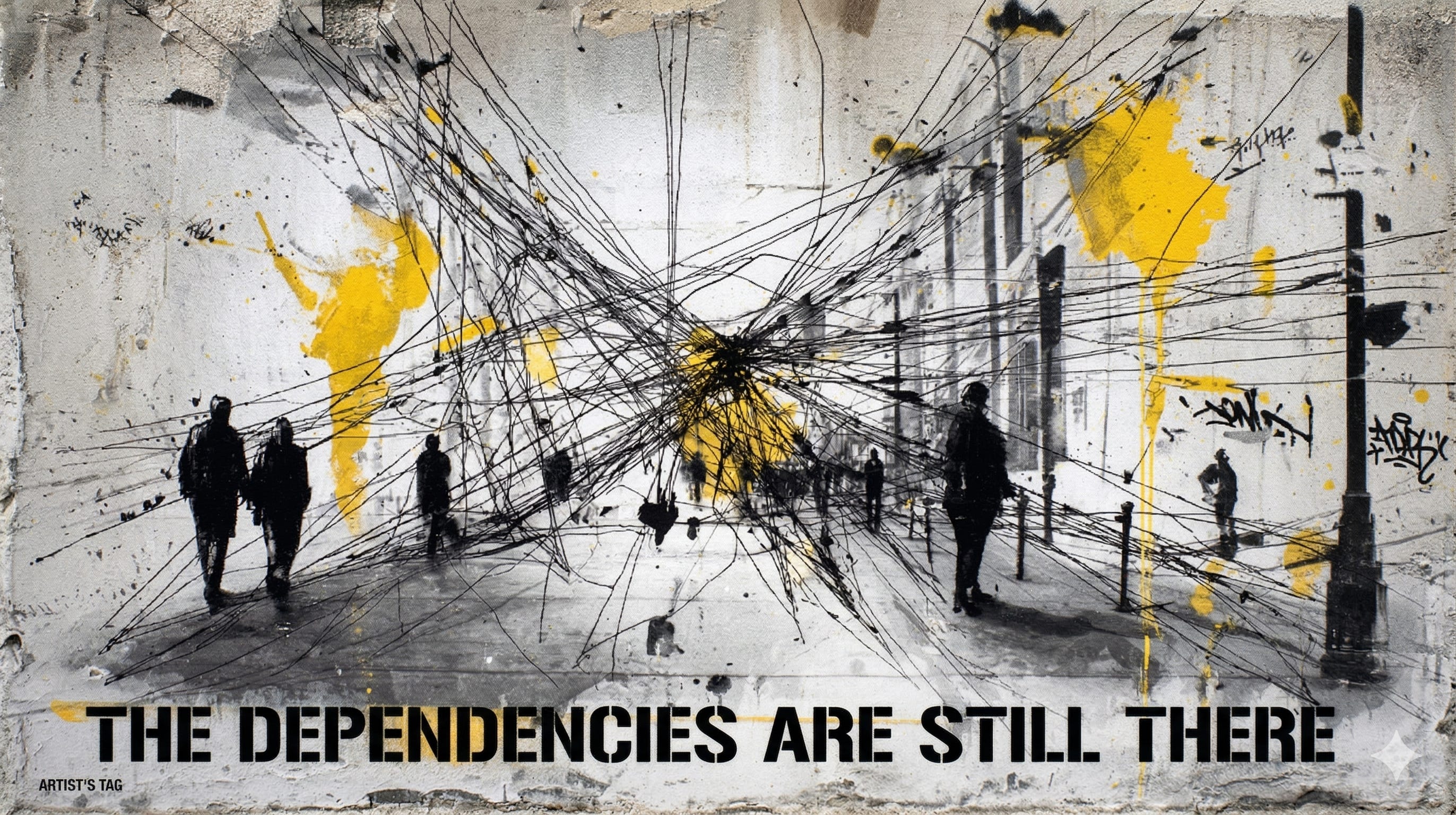
There is a counterintuitive truth at the heart of naive federation: it often creates more dependencies between teams, not fewer. In a centralised model, the dependencies were explicit and managed, however imperfectly, by the central team (at that stage, the central team’s job was control). In a naive federation, they are implicit, undocumented, and discovered at the worst possible moment. The instinctive response, better communication, stronger governance meetings, a new coordination role, cannot resolve this. Coordination overhead of this kind can only be reduced by reducing the number of coordination points through architectural design, not by adding process on top of them.
A domain that changes a field name in a data product, a report, or any other governed output can silently break downstream consumers it did not know it had. A governed output carries not just a schema, the agreed structure that tells one system what to expect from another, but a promise: about reliability, freshness, and the conditions under which it can be trusted. When a schema changes without warning, the agreement breaks silently and every team consuming it absorbs the consequence.
The Silent Contract Violation
In a well-designed system, the consequences of any change are bounded and knowable before the change is made. In a naive federation, they are discovered after. The same logic applies to every cross-boundary dependency: access models, customer definitions, transaction states. Each local decision made without visibility into downstream consumption is a silent contract violation waiting to surface.
There is a further failure mode that rarely features in federation design: boundaries are not static. Two domains that were originally independent can, as the organisation changes, become operationally coupled in ways nobody anticipated and nobody designed for. A product launch, a regulatory change, or a shift in business model can quietly make two previously separate domains dependent on each other’s definitions. Without a mechanism to detect that new coupling, the drift begins silently, and by the time the dependency becomes visible it has already become load-bearing.
Distributing ownership without the architectural conditions that make independence real does not reduce coupling. It relocates it. The result is a system with all the coupling of a centralised architecture but none of the clarity, and the failure only becomes apparent when the organisation tries to do something that requires the whole to function as a coherent system.

When Local Optimisation Becomes Collective Blindness
The Measurement Trap
There is a paradox at the heart of naive federation that the coupling problem alone does not explain. The disorder each domain exports to the system around it is not the result of carelessness or misalignment. A domain that has spent two years tuning its own models on its own definitions has built something of real value in its own context. The problem is that it has also made itself progressively less legible to the rest of the organisation, and nobody in that domain is being measured on legibility.
This is not a failure of awareness. The leaders of those domains are being entirely rational: they are measured on local performance, and the measurement system, meaning the totality of what gets counted, what gets reported, and what triggers a leadership response, makes local optimisation the only visible success criterion. This is the entropy tax operating at the domain level: the measurable cost an organisation pays when local optimisation exports disorder to the system around it. The term and its full mechanism are developed in The Entropy Tax, linked in the further reading. The collective blindness is not an accident. It is a designed outcome of the measurement architecture.
Over time the boundary design makes it not just rational but structurally easier to pursue local excellence than to examine systemic impact, and people do not merely stop looking across boundaries, they gradually lose the organisational permission and the habit of doing so.
The Structural Lock
What makes this condition particularly resistant to correction is an asymmetry that rarely gets named. The cost of coordination debt is paid by whoever tries to cross a domain boundary: the analyst reconciling two definitions of the same metric, the team building a cross-functional product, the executive trying to act on a single coherent picture during a strategic pivot. But the authority to invest in reducing that debt sits with the domain leaders who rarely cross those boundaries themselves and therefore rarely feel the cost directly. The pain and the power to address it are held by different people, which is precisely why the debt compounds without triggering the correction that would be automatic if both were held by the same person.
The cost falls due most visibly at the moments organisations can least afford it. When a regulator asks an organisation to explain how a decision was made, the answer needs to cross domain boundaries cleanly: which data was used, in what state, governed by which rules, at what point in time. In a naive federation, assembling that answer requires reconstructing an archaeology of local decisions, incompatible schemas, and undocumented assumptions. Critically, no single domain is at fault. Each made defensible local decisions. The failure belongs to the boundary design: a system built without the contracts that would have made cross-domain lineage traceable. Governance coverage on a slide and governance capability in practice are different things, and the distance between them tends to be revealed at exactly the moment when the cost of that distance is highest.

The Difference a Grammar Makes
The Navigability Problem
The regulatory exposure described above is not primarily a technology problem. It is a navigability problem: the organisation cannot produce a coherent account of its own behaviour because its domains never agreed on how to make their representations translatable to each other. The distinction between naive and principled federation is not about technology. It is about whether shared standards are treated as a constraint on local autonomy or as the foundation that makes local autonomy possible. The essay builds toward a harder claim still: principled distribution, which demands not just better governance of the federated model but a different starting question entirely.
Where Domain Boundaries Actually Sit
Before that distinction can be made in practice, there is a prior question most organisations answer incorrectly: what is a domain, and where does its boundary sit? A domain is not a business unit, a team, or a system. Its coherence is a matter of shared meaning, not org charts or system boundaries. Where shared meaning ends is where the domain boundary should sit, regardless of how the org chart is drawn.
Vocabulary is the most legible signal of that boundary, but the signal can mislead: two teams using the same word while meaning different things by it are already operating in separate domains, regardless of how the terminology looks from the outside. Two units with separate processes but genuinely shared meaning constitute one domain. Two with overlapping systems but diverging meaning constitute two. Organisations that draw domain boundaries around existing systems and reporting lines rather than around shared meaning create the conditions for incoherence before any governance decision has been made.
Grammar, Not Dictionary
What makes a federation legible across its parts is not a shared dictionary, not a single agreed definition of every term, but a shared grammar: common structures for how meaning is expressed, verified, and communicated across boundaries. Each domain retains its own operational dialect, shaped by the reality it serves. What it cannot do, without incurring coordination debt on everyone else, is make that dialect untranslatable.
The instinct when meaning diverges is to converge it: build the enterprise ontology, get everyone to agree on the canonical definition. That instinct is not wrong in principle. It is wrong in sequence.
Legal, operations, and finance hold different and legitimate conceptualisations of the same reality. Those differences are not opinions to be overridden. They are operationally necessary representations, each calibrated to a different kind of decision, and forcing convergence before the operational work is done does not eliminate the difference, it merely hides it until it surfaces as an error. (Not all divergence is legitimate, of course. Some is accumulated sloppiness. The endnote returns to that distinction.)
The Ontology as a Map
The enterprise ontology is better understood as a map of where the paths fork: where representations diverge from a shared origin, where they run parallel under different names, and what each crossing between them preserves or loses. Not a precondition for starting. A record of what the terrain actually looks like.
The instinct, however, is to build it as a system rather than a map: to translate the ontology into a technical information model and implement it as infrastructure. That is a different thing, and it answers a different question.
The Risk of Emergent Meaning
The opposite instinct, letting meaning emerge from data rather than agreeing it upfront, carries its own risk. An ontology that crystallises from use rather than from deliberate design can become load-bearing before anyone has examined whether it is right. Early decisions about representation get embedded in live systems and automated processes, and the cost of changing what something means grows with every workflow that depends on it. The organisation that moves fast on emergent meaning may find itself governed by definitions that were never deliberately chosen, only inherited from whatever the source systems happened to encode first. Neither sequence is safe. The difference is which failure mode the organisation is better positioned to recover from.
The goal of shared standards is not to produce agreement on meaning. It is to make disagreement navigable.
Most naive federations fail not because domains disagree on definitions, but because they stop investing in the translation infrastructure that would make those differences navigable. The result is authoritative incoherence: every domain internally consistent, locally auditable, confident in its own version of reality, and a cross-functional question returning a different answer depending on which domain it is put to. Every domain has a source of truth. The organisation has none.
The Debt Beneath the Incoherence
Semantic debt is the form this takes at the deepest level, accumulating not in workflows but in the definitions themselves. Unlike technical debt, which stays within a team, it is relational, accumulating in the gaps between teams. A domain can have immaculate code and zero technical debt while drowning in semantic debt because its definitions have quietly drifted from the rest of the organisation. Those definitions embed themselves in live systems and automated processes, and the longer they evolve independently the more load-bearing they become.
Is stable, shared meaning even the goal? The harder answer is that permanent agreement on meaning is not a destination we have failed to reach. It is a destination that does not exist. Meaning is always local, always temporary, always contextual. Different parts of an organisation will always understand the same concept differently, not because they are not trying, but because that is how meaning works. This is not a problem to fix. It is the condition to design for.
The translation layer is what makes that condition liveable, but only if it is maintained as a live service rather than treated as a project to complete. An organisation that treats meaning alignment as a project will defund the work the moment it feels stable, which is precisely when the next drift begins accumulating unnoticed.
If nobody is alerted when a mapping between domain representations breaks, the organisation has a document, not a service.
Meaning cannot be governed directly. What can be governed is how meaning behaves at the boundary. The central team’s job has shifted twice: from controlling data in centralisation, to becoming the bottleneck in naive federation, to maintaining the boundary grammar in a principled one. That grammar covers the contract formats, policy frameworks, observability standards, and translation layers that let domains interoperate without a bespoke integration project each time. Critically, the grammar defines what domains must not do at the boundary, not how they must operate within it. A grammar that specifies prohibited behaviours produces genuine domain freedom inside clear limits. A grammar that prescribes methods produces permission-seeking dressed up as federation. It builds the paved roads. It does not drive every car.

What Principled Federation Actually Demands
The Re-centralisation Temptation
There is a predictable moment in most federation journeys where an organisation realises it has created a problem it does not have a ready name for. The domains are moving fast. The central team has been reduced or redistributed. And yet the organisation is somehow slower, on the questions that matter most, than it was before. The temptation to re-centralise is strong, and worth resisting. It misreads a governance failure as an architectural one. The governance failure is the absence of shared standards and enforceable contracts across domain boundaries. Consolidating data back into a central repository addresses the symptom without touching the condition that produced it. The problem was never distribution. The problem was distribution without the standards, contracts, and grammar that make it coherent.
The instinct that drove centralisation has simply migrated. Call it the LegacyCo reflex: the organisational habit, built over decades of centralised data infrastructure, of treating location as the primary governance lever. Where data lives becomes a proxy for who controls it, and control becomes a proxy for governance. The reflex survives the move to federation because the underlying assumption, that governing data means owning where it sits, travels with the people who built their careers inside it.
This is not a failure of intelligence. It is a rational response to the incentives and constraints that shaped how most organisations built their data capability, and it made sense for as long as the centralised model was the only viable one. In a centralised model it expressed itself as a single guarded repository. In naive federation it expresses itself as a collection of locally guarded repositories, each domain confident in its own version of reality, the whole organisation progressively less able to act on shared ones. Genuine federation governs data by enforcing how it behaves wherever it originates. That changes what counts as done for the teams that own source systems, which is a harder ask than any coordination layer ever required.
Principled federation gets the governance right. Principled distribution goes further: it treats distribution itself, not federation as a pattern, as the design intent from the outset. The difference is not semantic. It is the difference between fixing the known failure modes of a model and questioning whether the model was ever the right starting point. In practice: a federation response detects a broken schema contract and patches the downstream consumer. A distribution response asks why the contract existed without an enforcement mechanism, and who owns that gap.
What Principled Distribution Requires
It also means accepting a harder form of accountability. In a principled federation, whoever designs the boundaries within which domains operate owns the consequences those boundaries produce. Not the team that changed a field name. Not the agent that followed a drifted identifier. The person who designed a system without the contracts that would have made the drift detectable. Most organisations find it easier to re-centralise than to hold that kind of ownership with genuine discipline. And where the designer lacked the authority to enforce the contracts the architecture required, the accountability travels further: to whoever designed the authority structure that made that enforcement impossible.
What makes it genuinely difficult is that the same asymmetry that compounds coordination debt in the Structural Lock reappears here at the enforcement layer. Who monitors the translation layer, who is alerted when a mapping breaks, and who has the standing to require a domain to act: these are not implementation details. They are the accountability architecture, and leaving them unresolved is what turns a well-designed grammar into a document nobody is responsible for keeping honest.
Coherence in a distributed system is an engineering discipline, not an organisational aspiration. In practice it looks less like a new platform and more like a small set of unglamorous guarantees: every published governed output carries a contract that can be validated, policy is enforced where data is first produced rather than where it is eventually stored, and every cross-domain question can trace which representations it passed through on the way to an answer.
This work shows up not as wins on a roadmap but as the absence of the failures that would otherwise have compounded.
The Agent Amplifier
In a naive federation, agents are not faster users. They are automated debt-collectors: every coordination debt the organisation deferred, every semantic drift it tolerated, gets collected at machine speed without pause. The analyst who notices a number looks wrong is the last circuit breaker against that drift. Agents remove the pause entirely. That is not a scalar difference. It is a qualitative one: the circuit breaker is gone, not slower.
The failure mode to watch for is not outputs falling outside expected ranges, which monitoring can detect. It is outputs that are within range and operationally wrong, because the metadata they depended on changed without notification. That pattern exists today in organisations without a single agent in their architecture. Agents simply make it faster, broader, and considerably harder to unwind. The endnote returns to what this means for organisations that have not yet built the governance architecture before agents begin operating at scale.
Getting the architecture right is necessary. It is not sufficient. The final obstacle is not a design problem at all.

The Vocabulary Trap
There is one failure mode that sits outside the architecture and yet determines whether the architecture matters at all. The vocabulary of principled federation will be adopted faster than the practices it describes. That gap is not a cultural lag. It is a structural one.
Vocabulary updates in months. The mental models that determine how people actually interpret and apply that vocabulary shift over years. And the incentive structures that determine what people do when no one is watching, the only layer that reliably changes behaviour, are slowest of all.
Organisations will rename their governance committee a translation layer. They will call their schema documentation a contract. They will describe their central team as building paved roads while it continues approving tickets. They will call their technical information model an enterprise ontology. The LegacyCo reflex, the habit of treating location as the primary governance lever, does not disappear when the vocabulary updates. It migrates into the new terminology. Organisations that have renamed their central repository a data mesh are often still governing by location. The words will update. The practices will not.
The Authority Gap
The gap between words and practice is not primarily a cultural failure. It is an authority one. The function responsible for maintaining the grammar almost always has the standing to define it, but rarely the standing to require domains to honour it when a release schedule or a local priority pushes back. A translation layer nobody has the authority to enforce is not a translation layer. It is a document. An enterprise ontology nobody is accountable for keeping aligned with live domain representations is not a logical map of how the organisation thinks. It is a record of how it once intended to. The same logic applies to the obligations principled federation creates more broadly.
Those obligations are real costs, and there are legitimate cases where an organisation consciously decides a particular one is not worth its price. The problem is that most organisations never surface the obligation in the first place. What looks like a deliberate trade-off is usually organised avoidance: the cost is paid anyway, invisibly, through compensating quality work far from the source and decisions that fail in ways nobody can trace back to their origin. Conscious choices made in daylight are defensible. The accumulated cost of obligations that were never named is not.
The measurement system that makes coordination debt invisible, the incentive structure that rewards local delivery velocity, the leadership responses that treat cross-domain friction as noise rather than signal: these are not cultural problems sitting outside the architecture. They are the architecture. The formal contracts governing governed outputs can be as well-designed as the grammar allows. But every organisation runs on two architectures simultaneously: the formal one, the contracts, standards, and governance rules, and the organisational one, what actually gets rewarded, what gets escalated, what counts as progress in the day-to-day. When these two diverge, the organisational architecture wins. Silently and completely.
This is not a metaphor. The measurement system, the incentive structure, and the leadership response pattern are as load-bearing as any schema or contract. They are just harder to version, harder to audit, and impossible to enforce through tooling alone.
The architectural argument in this essay is necessary but it is half the job. The harder half is changing what the organisation measures at the boundary, what leadership responds to consistently, and what counts as progress when progress is invisible on any standard dashboard. Those are not architectural decisions. They are human ones.
The architecture creates the conditions. The organisation has to choose, repeatedly and under pressure, to honour them.
Federation was never the answer to centralisation. Principled distribution is. The difference between them is the work most organisations decided they could skip.
Which architecture is your organisation actually running?
Further reading
The Data Platform Was Never a Place: the companion piece reframing what a platform is before asking how to govern it across distributed domains.
Federated Governance Series: the series this essay introduces, covering The Foundation Decision, The Translation Investment, The Cost of Distribution, and The Accountability Decision.
Stop Performing Transformation: a trilogy on why data transformations produce organisational theatre rather than structural change. A companion argument to the Vocabulary Trap from the leadership and strategy side.
The Entropy Tax: develops the mechanism behind the Collective Blindness section: the measurable cost an organisation pays when local optimisation exports disorder to the broader system.
Where Meaning Comes From: examines whether meaning must precede data or can emerge from it, and why the sequence shapes everything that follows.
An honest endnote
This essay argues that principled distribution is achievable and worth the discipline it demands. What it does not address is what minimum viable principled distribution looks like for an organisation starting from a poorly governed baseline, one where source systems were never governed consistently, semantic debt has been accumulating for years, and the authority structures that would enforce shared standards do not yet exist. The sequencing argument is sound: you cannot build coherent federation on incoherent foundations. The federated governance series linked above takes up that question, beginning with The Foundation Decision.
What the essay also leaves open is the prior question of what is common across domains and therefore worth standardising rather than translating. Not all local variation is operationally necessary. Some of it is unresolved process debt. The translation layer is not a substitute for that work. It is what makes the remaining legitimate differences navigable once the unnecessary ones have been resolved. That distinction is developed further in The Translation Investment.
The agent dimension also deserves more than this essay gives it. An agent does not pause. There is no circuit breaker. The failure mode described in The Agent Amplifier section above propagates at machine speed, across every process that depends on it, before anyone has noticed the ground shifted. Getting the governance architecture right before agents are operating at scale is not a preparation task. It is the task.
The essay argues that principled distribution is achievable, but it does not claim the conditions for it exist in every organisation. The authority structures it requires often do not exist and cannot be assumed into place. Some organisations will need to build those conditions before they can build the architecture, and that is a longer and harder journey than this essay describes. Acknowledging that is not a retreat from the argument. It is the argument made honestly.
This essay is written close to the work, not from a distance. If something here reflects what you are seeing in your own organisation, or if something important is missing from the argument, that is where the next version begins. The discussion is open for exactly that purpose.