

The essays can be read in sequence or independently. They share a vocabulary and a point of view, but each makes a complete argument on its own.
The Context
Data platforms are built to be handed over.
This is not what happens.
What happens is that the platform is built, and then it must be operated. The signals it generates need people close enough to the work to interpret them. The domain teams using it need presence that builds their capability rather than substitutes for it. The shared meaning that makes its outputs useful needs continuous maintenance that no platform feature can provide. And the incentive system that was in place before the platform arrived is still in place after, governing behaviour in ways the platform cannot see and the governance dashboard cannot report on. That last point is the one most platform strategies do not name: the invisible architecture of what gets measured and rewarded is the system that actually runs the organisation, and it changes last.
The essays in this series each address a failure mode of this kind. Each one is structural rather than operational. Each one is invisible until it becomes undeniable. And each one is a leadership problem before it is a technical one.

The Essays

Most data platform failures are not technical. They are the result of treating exception systems, presence, and delegation as a maturity sequence rather than a simultaneous system. This essay names the three motions, the failure mode that follows from getting each one wrong, and the fourth condition that makes all three look present when none of them are working.

The dashboard shows green. Quality gates are passing. Contracts are enforced. And somewhere in the organisation, a product team has quietly stopped using the certified data pipeline and built their own. This essay examines the structural gap between what exception systems can see and what is actually going wrong, and what presence actually does that no dashboard can replicate.
Read this one first if you are coming to the series through the governance question.

The most capable platform leaders are often the ones most likely to create the problem this essay is about. Not because they make bad decisions, but because they make good ones, reliably, in every cross-domain situation that requires them. This essay names the distinction between presence that builds domain capability and presence that substitutes for it indefinitely, develops the three structural tests that reveal which kind a platform team is actually providing, and names what the transition from one to the other actually requires.
Read this one second if you started with the governance essay.

The data is there. The dashboard is built. The report lands every Monday. And the decision that needed it was made on gut instinct by Thursday, because nobody could agree on what the numbers meant. This essay argues that legibility, the property of information that makes shared interpretation possible, is structurally distinct from accuracy and accessibility, that more data actively undermines it past a certain point, and that the three conditions that produce shared understanding cannot be supplied by any platform feature. It is best read as the synthesis of what the three motions are ultimately for: not just better platforms, but shared understanding of what the platform produces.
This essay makes its argument without requiring the others. The series vocabulary enriches it.
The Shared Argument
These essays do not add up to a framework or a methodology. They add up to a diagnosis. The sequence is: name the mechanism, make the cost visible, give leaders the vocabulary to act on what they are already seeing but may not yet have words for.
The diagnosis is this: data organisations have invested heavily in the visible architecture, the platforms, the governance frameworks, the self-service tools, and systematically underinvested in the conditions that make the visible architecture work. Those conditions are organisational rather than technical. They require leadership behaviours that are difficult to sustain at scale. They decay without active maintenance. And they are invisible on every dashboard that was designed to measure the platform rather than the organisation around it.
Building the platform is the part that gets funded. Operating it sustainably is the part that gets assumed.
A data platform is not a thing you build and hand over. It is a system you operate, continuously, through all three motions at once.
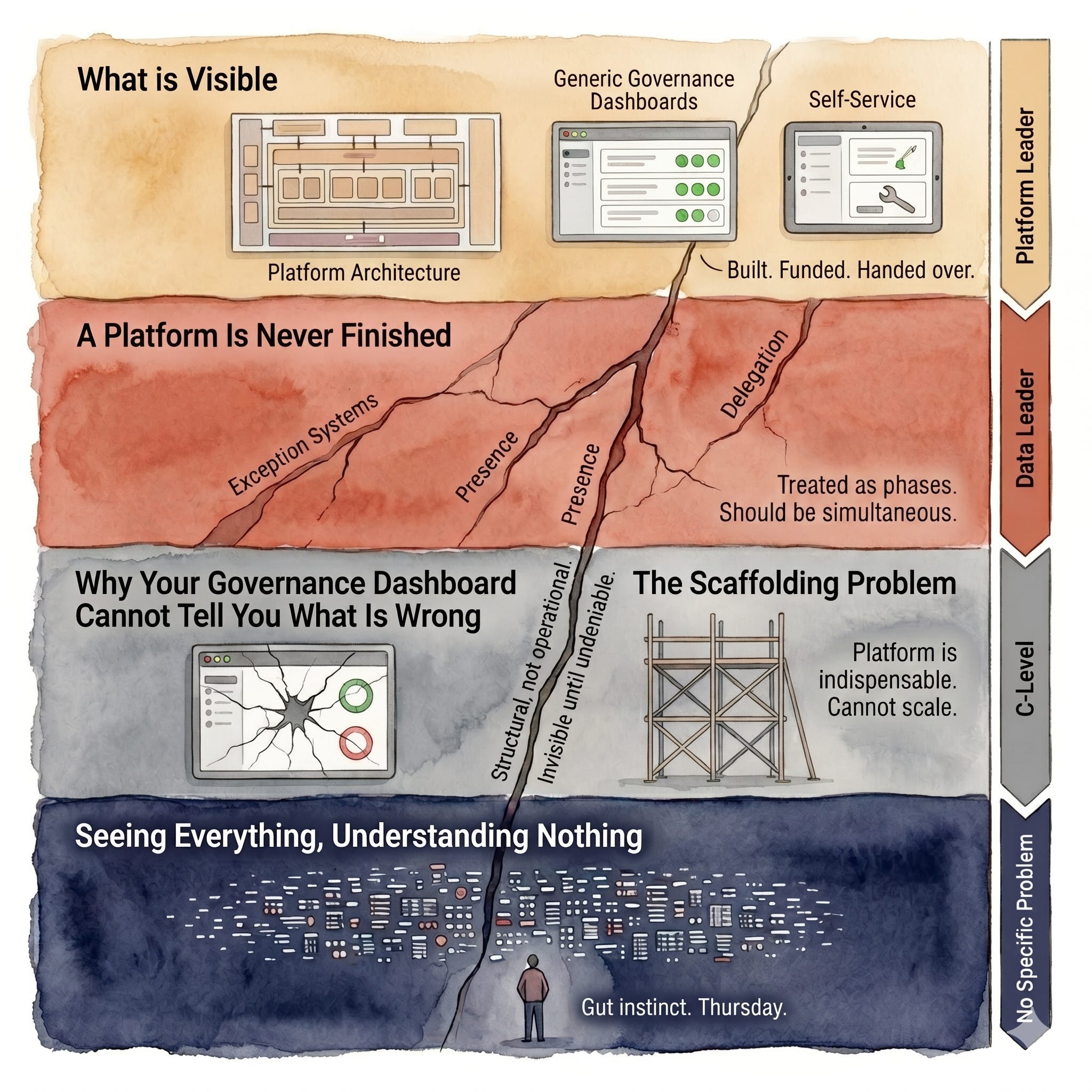
How to Read This Series
If you are a platform leader wondering why your governance metrics look healthy while your domain teams are quietly working around the platform: start with the governance dashboard essay, then the scaffolding essay.
If you are a data leader trying to understand why your organisation has full visibility but still makes decisions on instinct: start with the standalone essay on legibility, then read the parent essay for the broader framework that explains why. The inversion is deliberate: the legibility essay is the more accessible entry point if you are not yet thinking in platform terms.
If you are a C-level leader trying to understand why data investments keep underdelivering relative to expectation: start with the parent essay, which names the three failure modes at the system level, then follow whichever companion addresses the failure you recognise most immediately.
If you are arriving with no specific problem and want to understand the series as a whole: read in order. The argument builds.
These essays are field notes in the original sense: observations written close to the work, not from a distance. A published piece is not a finished argument. It is a tested one, sent out to be challenged, refined, and occasionally overturned by what readers bring back from their own contexts. The discussion section under each essay exists for exactly that reason.