
Here's a puzzle: Hospitals installed AI that reads medical scans better than most doctors. Six months later, they were hiring more radiologists, not fewer. The AI wasn't broken—it revealed something we've completely missed about human work.
The parts of your job that truly matter aren't the tasks you can list on a resume. They are the invisible connections between those tasks. This is the "ghost in your job," the essential, unseen work that can't be automated.
It’s the project manager who sees the team switch to thumbs-up emojis and knows morale is tanking.
It’s the salesperson who hears a three-second pause after discussing price and knows to address budget concerns before they become unspoken objections.
It’s the veteran mechanic who hears a faint engine noise and knows it’s the real problem, not what the diagnostic report says.
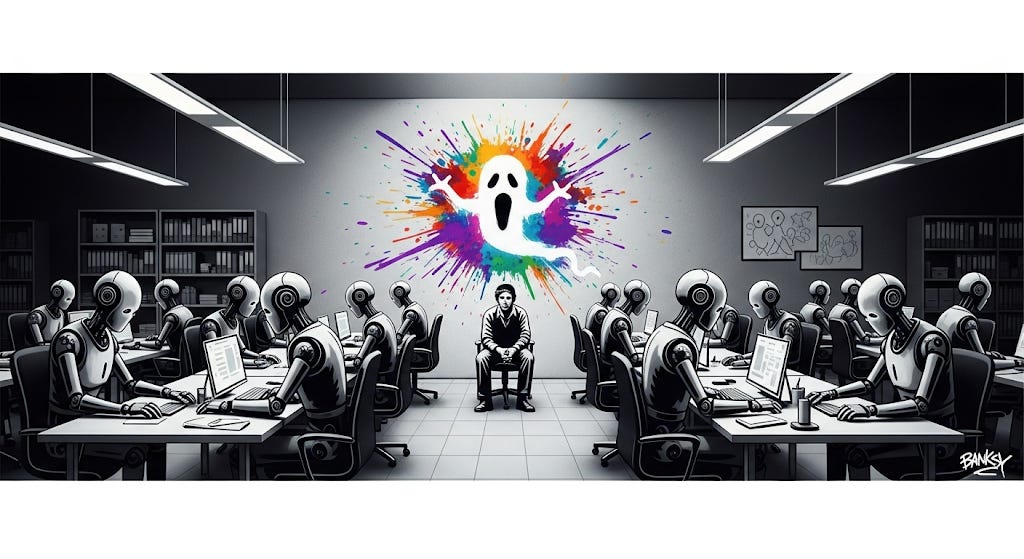
AI researcher Melanie Mitchell has shown that technologists consistently underestimate this complexity. They see radiologists as people who "read X-rays," rather than as diagnosticians who must weave together patient history, ambiguous imaging patterns, and clinical intuition to solve a medical mystery.¹
So, what should you do?
Audit your ghost work. What do you do that never appears in your job description? Identify the moments of judgment, empathy, and creative problem-solving you perform every day. That’s your true value.
Partner with AI, don’t compete. Let automation handle the routine, and focus your energy on the messy human stuff where you excel. The most valuable professionals won't be replaced by AI; they'll be the ones who work with it best.
Question the hype. The next time someone claims AI will replace an entire profession, ask what invisible work they're missing.
The next time someone asks if AI can do your job, smile. They're asking the wrong question.
The real question is: can AI navigate the beautifully messy, endlessly human world where your actual work happens?
That's your ghost—and it's here to stay.
¹ For those interested in a deeper, more nuanced understanding of AI's capabilities and limitations, I highly recommend following the work of Melanie Mitchell and Arvind Narayanan. You can find them on LinkedIn and their excellent Substack newsletters, which provide critical perspectives on AI hype.
Follow: Melanie Mitchell on LinkedIn and Arvind Narayanan on LinkedIn.
Read: Mitchell's AI Guide at aiguide.substack.com and Narayanan´s AI Snake Oil (co-authored with Sayash Kapoor) at aisnakeoil.com.
Read: A fantastic recent conversation between them, "A Guide to Cutting Through AI Hype", is available on the Princeton CITP blog.