

The Constraint Dissolution Revolution
How Modern Organizations Achieve Good, Fast, AND Cheap

Why the Iron Triangle Became a Mental Prison—and How to Break Free
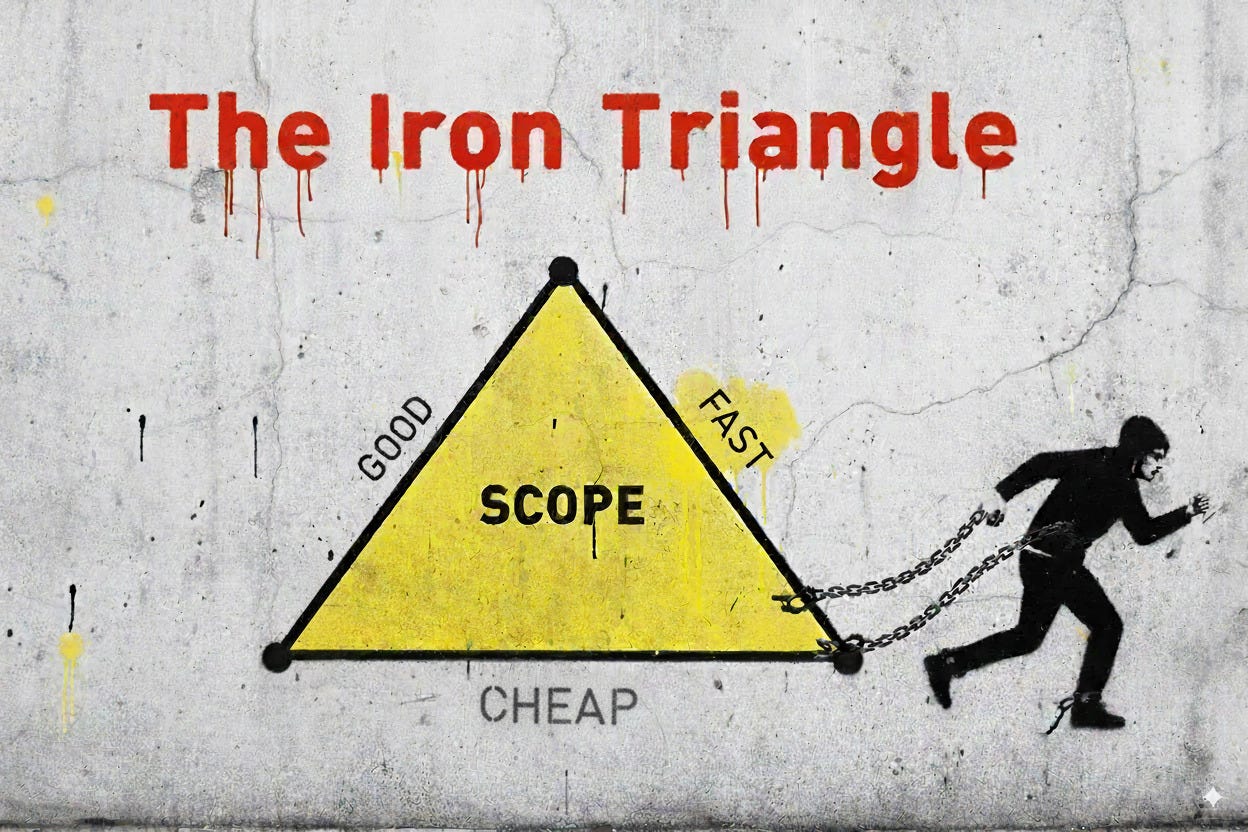
You've seen the slide before: a triangle with "Good," "Fast," and "Cheap" at each corner, accompanied by the consultant's time-worn wisdom—"Pick two." The room full of executives nods knowingly. After all, this Iron Triangle has guided project decisions for over sixty years, from 1960s project management to today’s software sprints. It feels like immutable physics—a natural law of organizational reality.
But what if this foundational assumption isn't just outdated, but actively constraining your organization's potential?
The Iron Triangle reflects what we might call LegacyCo thinking—a worldview where constraints are permanent fixtures, trade-offs are zero-sum games, and optimization means choosing which limitation to accept. This mental model made perfect sense in an era of stable requirements, predictable processes, and centralized decision-making. But it becomes a cognitive prison in a world where modern platforms, data architectures, and AI enable the most successful organizations to systematically dissolve constraints rather than simply managing them.
Shifting the Performance Curve: From Trade-offs to Economies of Speed
Consider a modern platform-oriented organization. When they invest in proper abstractions and computational governance, something remarkable happens: the traditional constraint relationships begin to break down. What initially appears as choosing between good, fast, and cheap gradually transforms into achieving all three simultaneously—not through magic, but through constraint dissolution.
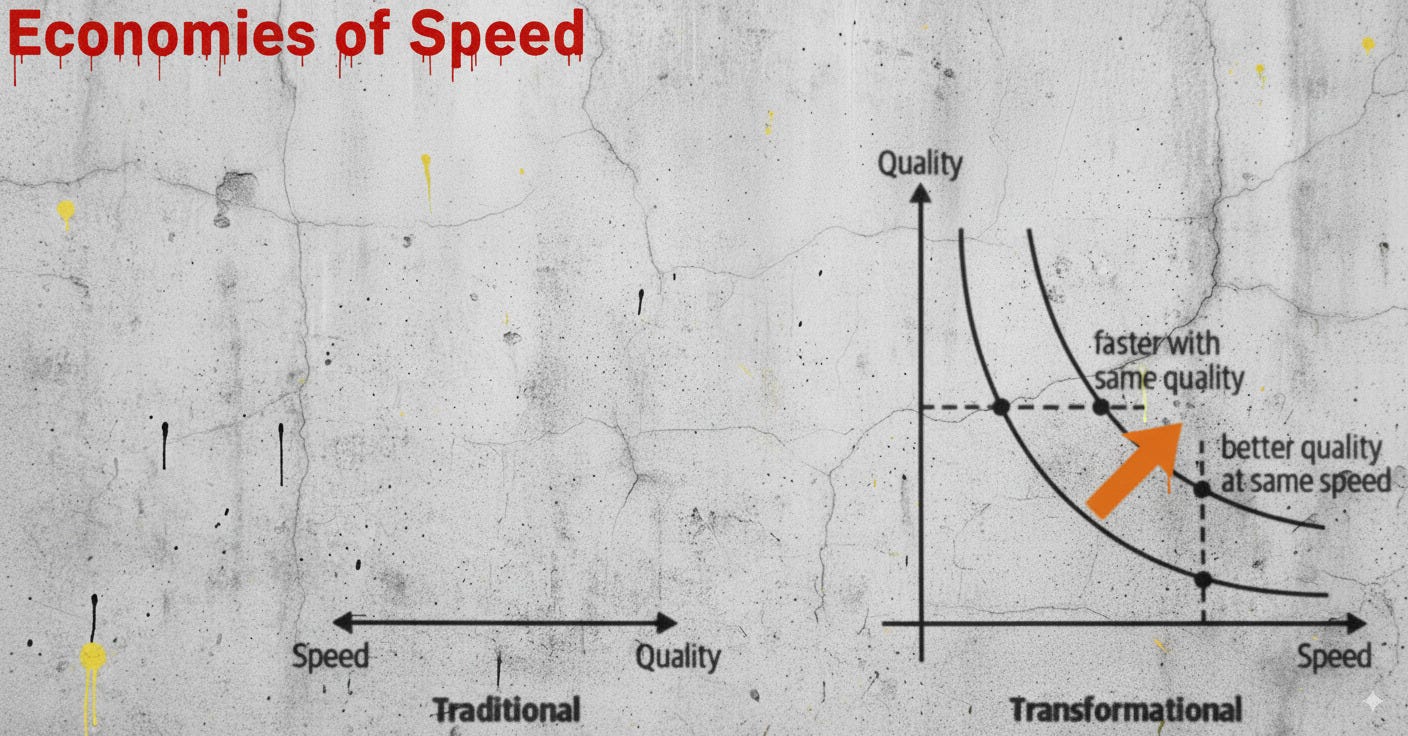
This transformation can be visualized through what we might call Economies of Speed—imagine the classic downward-sloping trade-off curve bending upward as capabilities are systematically built. Traditional thinking assumes a fixed relationship where increasing speed necessarily reduces quality—you're trapped moving along a predetermined trade-off curve. But transformational approaches don't just optimize within existing constraints; they shift the entire constraint curve outward, creating new performance possibilities where you can achieve both "faster with same quality" and "better quality at same speed" simultaneously.
The phenomenon mirrors how personal computers revolutionized document creation. Before word processors, producing a professional document required choosing between quality (expensive typesetting), speed (quick but crude typewriting), or cost (doing it yourself with limited results). The technology didn't just make existing processes faster; it fundamentally changed what constraints mattered—shifting the entire productivity curve to a new realm of possibility.
Similarly, organizations building modern data and AI capabilities discover that many assumed trade-offs simply evaporate. Teams deliver higher quality results faster and with lower ongoing costs—not because they've become superhuman, but because they've built systems that make the "right way" also the "fast way" and often the "cheap way." They're operating on an entirely different constraint curve than their competitors.
This represents the fundamental difference between LegacyCo coordination engines and NewCo learning engines. LegacyCo organizations optimize within constraints, accepting the traditional trade-off curve as immutable. NewCo organizations systematically invest in shifting the constraint curve itself, creating environments where velocity and quality reinforce rather than oppose each other.
The Platform Paradox: Investment That Eliminates Trade-offs
The most profound constraint dissolution occurs through what might be called the Platform Paradox. Organizations that invest heavily upfront in proper abstractions—creating reusable, simplified building blocks for technology—self-service infrastructure, and computational governance initially appear to violate the Iron Triangle by choosing expensive and slow approaches. Traditional leaders often balk at these investments precisely because they seem to sacrifice both speed and cost.
Yet these same organizations eventually discover they can deliver capabilities that are simultaneously faster, cheaper, and higher quality than traditional approaches. The platform investment doesn't just improve efficiency—it fundamentally changes the nature of work itself.
Consider how computational governance—where compliance rules and quality checks are embedded directly into automated systems such as CI/CD pipelines rather than enforced through manual review—transforms traditional compliance overhead. In LegacyCo organizations, ensuring data privacy, security, and quality requires manual processes that slow delivery and increase costs. The Iron Triangle appears inescapable: you can have fast delivery with basic compliance, thorough compliance with slow delivery, or some uncomfortable middle ground that satisfies no one.
But organizations implementing computational governance—where policies are embedded in automated systems rather than enforced through manual review—discover something remarkable:
The "governed way" becomes faster than ungoverned approaches because automation eliminates delays
It becomes cheaper because manual oversight becomes unnecessary
It delivers higher quality because automated systems apply standards more consistently than human processes
This perfectly illustrates the constraint dissolution dynamic in action. Rather than accepting the traditional constraint curve where governance creates trade-offs between speed and compliance, these organizations have shifted to an entirely new curve where governance actually accelerates delivery while improving quality. The constraint triangle hasn't been managed—it's been dissolved entirely through systematic capability building.

Learning Velocity: The Compound Advantage
The Iron Triangle assumes static organizational capability. But what happens when organizations optimize for learning velocity—the speed at which they discover and implement better approaches?
Traditional project management treats each initiative as independent, forcing the same constraint choices repeatedly. Team A chooses fast and cheap, delivering mediocre results. Team B chooses good and fast, accepting high costs. Team C pursues good and cheap, accepting long timelines. Each team faces the same fundamental trade-offs because organizational capability remains constant.
NewCo organizations operate differently. They treat each initiative as an opportunity to build capabilities that make future work fundamentally easier. Rather than accepting constraints, they systematically invest in dissolving them.
This learning-oriented approach creates what economists call increasing returns to scale—a key driver of this performance transformation. Each project not only delivers immediate value but also builds organizational capability that shifts the entire constraint curve outward. Teams become faster at delivery because they've built better tools. Quality improves because they've embedded lessons learned into automated systems. Costs decrease because repeatable patterns eliminate repetitive work.
The Iron Triangle assumes diminishing returns—that pushing one dimension necessarily compromises others, forcing movement along a fixed trade-off curve. But organizations optimizing for learning velocity experience expanding returns, where capabilities compound over time to shift the constraint curve entirely. They're not just getting better at managing trade-offs; they're eliminating the need for those trade-offs by operating in a fundamentally different performance space.
Dissolving the Innovation vs. Reliability Trade-off
This learning-oriented approach also resolves another classic tension that has long plagued organizations: the perceived conflict between innovation and operational reliability. Traditional thinking assumes these represent competing priorities, forcing organizations to choose between a culture of bold experimentation and one of operational excellence.
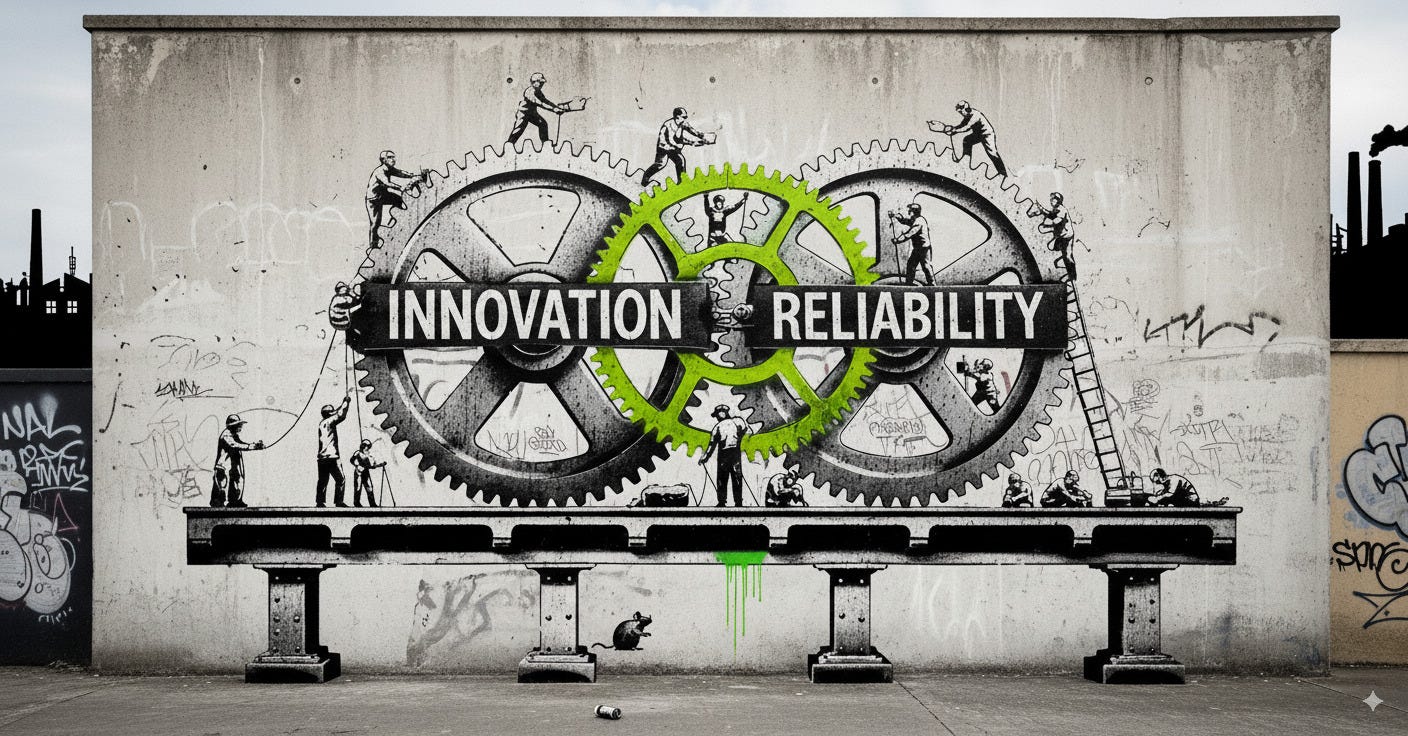
Consider how modern organizations balance rapid experimentation with reliable operations—what might be called the "twin engines" of innovation and delivery. Most leaders believe they must choose between these approaches, accepting either innovative but unstable environments or reliable but stagnant ones.
But constraint dissolution enables both simultaneously. Platform investments create stable foundations that make experimentation safer and faster, while experimental insights improve platform capabilities. Rather than managing tension between innovation and reliability, advanced organizations dissolve this constraint by building systems where both reinforce each other. Teams can experiment boldly precisely because they operate on reliable infrastructure, and that infrastructure becomes more reliable through continuous learning from experimental insights.

The AI and Data Amplification Effect
Artificial intelligence and modern data architectures accelerate constraint dissolution in ways that would have seemed impossible just a few years ago. When intelligence moves from centralized cloud systems to the edge—closer to where decisions are made—entire categories of constraints simply disappear.
Consider the traditional trade-off between personalization and scalability. Traditional thinking assumed you could either deliver highly customized solutions to few customers or standardized solutions to many customers. Organizations seemed trapped on a constraint curve that forced this choice.
But edge AI dissolves this constraint almost entirely by shifting organizations to an entirely new performance curve. Modern recommendation systems can deliver highly personalized experiences at massive scale with decreasing marginal costs—achieving what the traditional constraint model deemed impossible.
The constraint was never a law of physics; it was a choice of architecture. When intelligence operates where personalization decisions are made, traditional limitations become irrelevant.
Data initiatives reveal similar constraint dissolution patterns. Organizations implementing proper data product architectures discover they can simultaneously achieve faster time-to-insight, higher data quality, and lower operational costs. Traditional approaches forced choices between comprehensive governance and development velocity—you could have thorough data lineage and quality controls, or you could move fast, but not both. Modern data platforms with embedded computational governance eliminate this trade-off, making governed data more accessible than ungoverned alternatives.
The pattern repeats across numerous domains where AI and data capabilities intersect:
Real-time analytics eliminates trade-offs between comprehensive analysis and rapid response
Machine learning operations dissolve tensions between model sophistication and deployment reliability
Distributed data intelligence removes bottlenecks that previously forced choices between centralized control and domain agility
The Mental Model Prison
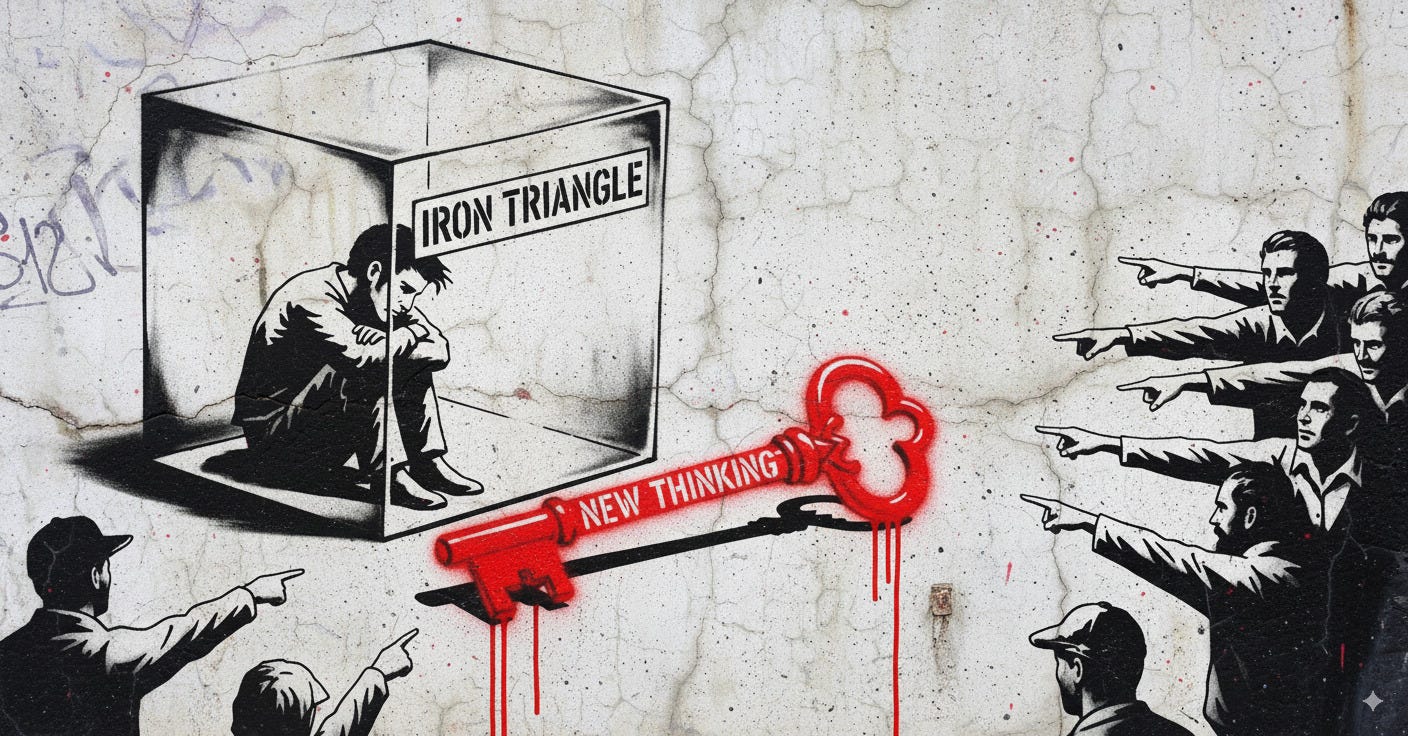
Why do so many organizations remain trapped in Iron Triangle thinking when alternatives exist? The answer lies in what might be called constraint cognitive capture—the tendency to treat current limitations as permanent features of reality rather than design choices to be evolved.
LegacyCo leaders, having built careers navigating traditional constraints, often possess deep expertise in trade-off management. They've developed sophisticated frameworks for choosing between good, fast, and cheap. They've learned to communicate these limitations to stakeholders and manage expectations accordingly. This expertise becomes a cognitive investment that resists fundamental change.
When presented with approaches that promise to dissolve constraints rather than manage them, LegacyCo thinking activates powerful defense mechanisms:
"Too good to be true"
"Not realistic for our industry"
"The investments required appear excessive"
This represents a profound form of what organizational scholars (Alvesson and Spicer) call functional stupidity—where capable individuals deliberately restrict their cognitive capabilities to avoid confronting uncomfortable realities. The Iron Triangle becomes a mental cage that prevents leaders from even considering whether constraints might be dissolved rather than simply managed.

Beyond Trade-offs: The NewCo Advantage
NewCo organizations approach constraints fundamentally differently. Rather than accepting the Iron Triangle as natural law, they treat it as a design challenge: How might we build capabilities that make traditional trade-offs irrelevant?
This shift from constraint acceptance to constraint dissolution requires different organizational reflexes. Instead of optimizing within current limitations, NewCo organizations continuously invest in expanding what's possible. Instead of managing trade-offs, they build systems that eliminate the need for trade-offs.
The measurement systems evolve accordingly. LegacyCo organizations track efficiency within constraints—how well they optimize given current limitations. NewCo organizations measure constraint dissolution velocity—how quickly they're building capabilities that expand what's possible.
This creates a compound advantage that becomes increasingly difficult for LegacyCo competitors to match. While LegacyCo organizations become more sophisticated at managing trade-offs along traditional constraint curves, NewCo organizations systematically shift to entirely new performance curves where traditional limitations don't apply. The performance gap widens not through superior execution within the same rules, but through operating on fundamentally different constraint curves that enable Economies of Speed—where velocity and quality reinforce rather than oppose each other.
The Diagnostic Questions
Organizations seeking to evolve beyond Iron Triangle thinking can assess their readiness through several diagnostic questions:
Do your organization's investment patterns focus on managing trade-offs better, or on dissolving constraints for future work?
Does your leadership's language center on "managing expectations" and "realistic constraints," or on "building capabilities" and "changing what's possible"?
Are your success metrics about optimizing efficiency within current constraints, or about the velocity at which you eliminate systemic barriers?
Does your organization view platform investment as overhead to minimize, or as capability investment that eliminates future constraints?
Do your project retrospectives focus on assigning blame for trade-offs, or on identifying which systemic constraints to attack next?
The gap between current responses and desired organizational direction reveals readiness for constraint dissolution approaches.

The Path Forward: From Managing to Dissolving
The transition from LegacyCo to NewCo constraint thinking doesn't happen overnight. It requires systematic investment in capabilities that may initially appear to violate the Iron Triangle but ultimately transcend it entirely.
Organizations beginning this transition often start with lighthouse projects—focused investments in constraint dissolution that demonstrate possibility without requiring organization-wide transformation:
A data team might invest in computational governance for one critical domain, discovering that automated compliance actually accelerates rather than slows development
A product team might build platform capabilities that eliminate future development bottlenecks, creating reusable abstractions that make the "right way" also the "fast way"
An operations team might implement edge AI that dissolves traditional trade-offs between customization and scale, enabling personalized service delivery without operational complexity
These lighthouse projects serve dual purposes: they deliver immediate business value while also building organizational confidence that constraints can indeed be dissolved rather than merely managed. They provide concrete evidence that the Iron Triangle represents design choices rather than natural laws.
Success requires patience with the investment paradox. Constraint dissolution requires upfront investment that may initially appear to violate cost and speed objectives. Leaders must maintain conviction that short-term constraint acceptance serves long-term constraint dissolution, even when traditional metrics suggest the approach is "expensive" or "slow."

The Future Belongs to Constraint Dissolvers
As artificial intelligence, modern data architectures, and platform thinking become increasingly mainstream, the performance gap between LegacyCo and NewCo approaches will widen dramatically. Organizations that continue optimizing within traditional constraints will find themselves competing against others that have eliminated those constraints entirely.
The Iron Triangle will persist as a useful framework for understanding traditional project management within stable, predictable environments. But the most consequential organizational work—building AI capabilities, creating platform advantages, transforming data into competitive assets—requires moving beyond constraint management toward constraint dissolution.
This isn't about abandoning trade-off thinking entirely. Even the most advanced organizations face genuine constraints and must make difficult choices. The difference lies in their fundamental orientation: while traditional organizations assume constraints are permanent features to optimize within, transformational organizations treat them as temporary design challenges to systematically dissolve.
The Iron Triangle isn't just outdated—it's become a constraint itself. And like all constraints, it can be dissolved by those willing to think beyond its boundaries. The future belongs to organizations that dare to shift the curve.