

This exploration builds on “The OKR Performance Theater“ and “From Targets to Learning“, which examined how well-intentioned management systems can suppress the thinking that breakthrough results require. Now we turn to a deeper question: why do some organizations seem to accelerate their learning while others, despite similar resources and access to information, remain trapped in increasingly obsolete approaches?
Consider two companies facing the same market disruption. Both have access to identical information about changing customer preferences. Both employ intelligent people who read the same industry reports and attend the same conferences. Both even acknowledge the need to adapt.
Yet one company rapidly evolves its approach while the other continues refining a strategy that grows less relevant with each passing quarter.
The difference isn’t about access to information or even acknowledgment of the need to change. The critical distinction lies in something more fundamental: their organizational capacity to absorb what they encounter.
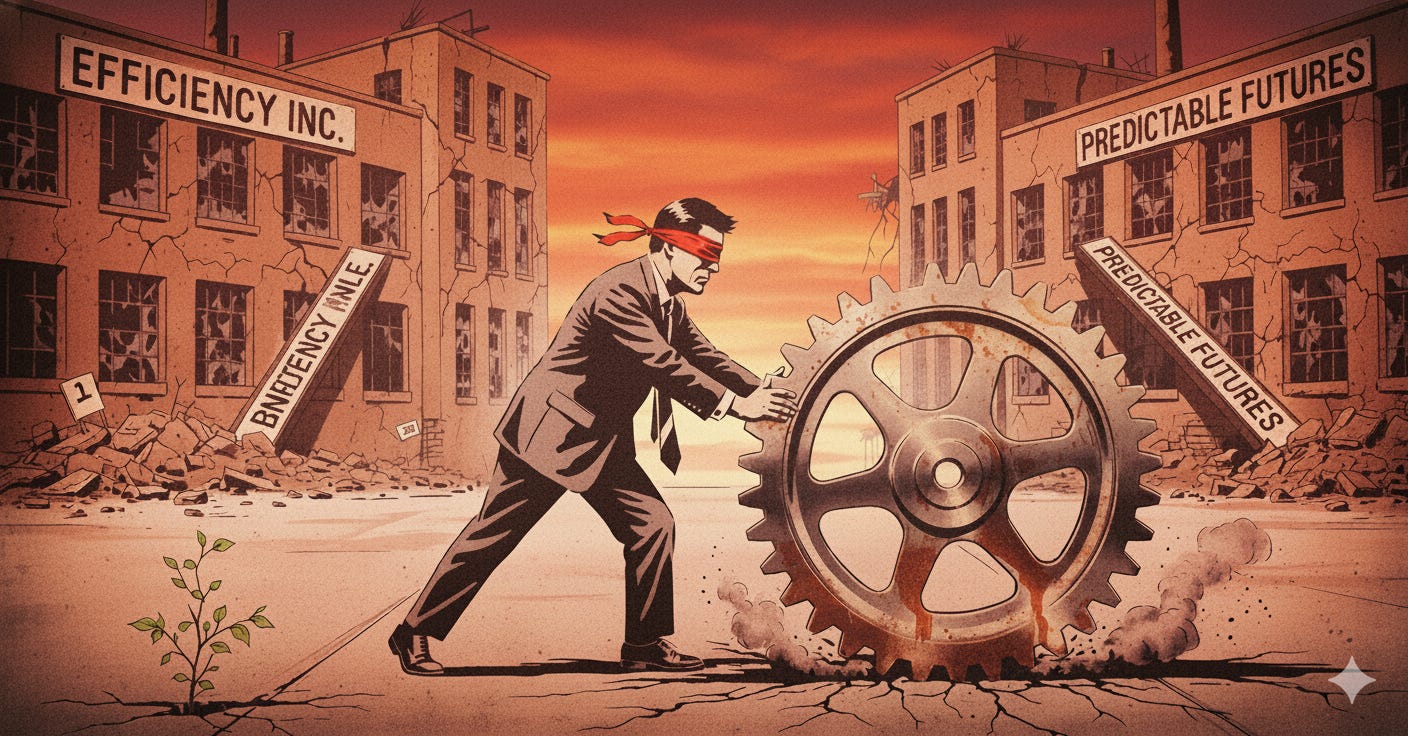
The Invisible Capability
Organizations invest enormous resources in knowledge management systems, innovation programs, and learning initiatives. Leadership teams commission research, hire consultants, and gather competitive intelligence. The information flows freely.
Yet many organizations struggle to extract value from this abundance. They possess the data but cannot metabolize it into meaningful action.
This puzzle reveals what organizational researchers Cohen and Levinthal termed absorptive capacity—the ability to recognize valuable external knowledge, assimilate it into organizational understanding, and exploit it to create value. Think of it as organizational digestion. Some organizations extract nutrition from new information and convert it into capability. Others consume the same information but pass it through unchanged, unable to transform knowledge into adaptive action.
What makes absorptive capacity particularly consequential is its cumulative nature. Organizations that continuously invest in this capability become progressively better at learning. Their capacity compounds over time, creating an accelerating advantage.
Conversely, organizations that neglect this capability face a devastating form of path dependence: once they fall behind in rapidly evolving domains, they may never regain the ability to assimilate and exploit new information, regardless of how valuable or accessible that information becomes.
The tragedy is that most organizations don’t recognize they’re destroying this capacity until long after the damage has been done.

The Performance Theater’s Hidden Cost
The connection to target-oriented management becomes clear when we examine what absorptive capacity actually requires. Later research by Zahra and George expanded the concept, showing that organizations develop this capability through four interconnected activities:
recognizing which external knowledge matters,
acquiring that knowledge,
transforming it to fit their context, and
exploiting it to create value.
Each stage demands cognitive capabilities that target-oriented systems systematically suppress.
Filtering Reality
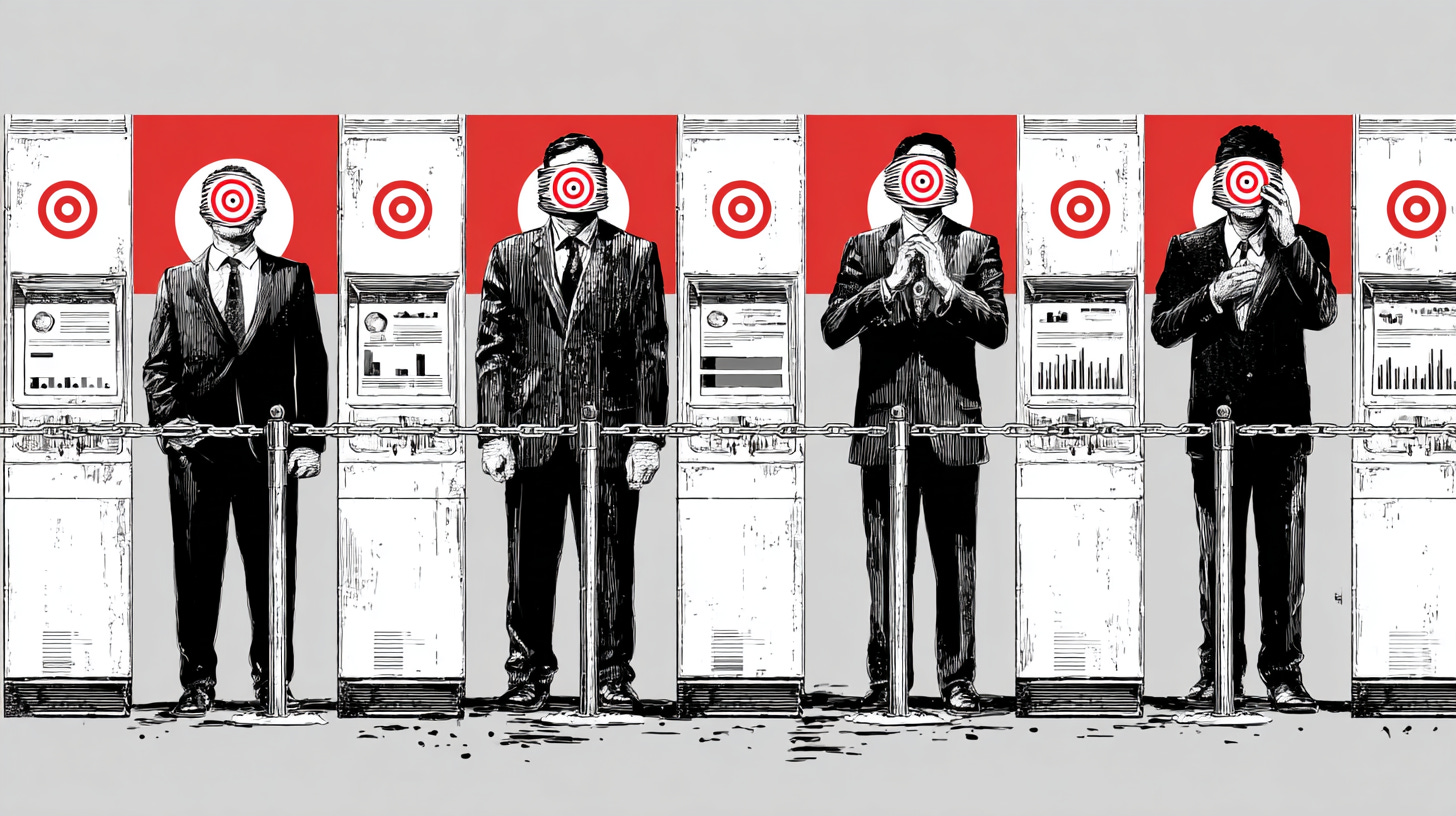
Recognizing valuable external knowledge requires genuine curiosity about information that might contradict current assumptions. But organizations operating under OKR theater learn to filter ruthlessly for information that supports committed objectives. Teams develop skilled pattern recognition for evidence that confirms their plans while systematically overlooking signals that suggest different approaches might create more value.
The quarterly rhythm reinforces this filtering. When teams have committed to specific key results, information that suggests changing direction becomes noise rather than signal—something to be noted for future planning cycles rather than incorporated into current thinking.
The Consistency Trap
Assimilating external knowledge demands the ability to question and revise mental models based on new evidence. Yet the performance theater rewards consistency over adaptation. Teams that maintain steady progress toward predetermined targets receive praise and autonomy. Those who propose significant course corrections based on new understanding face increased scrutiny and requests for detailed justifications.
The implicit message becomes clear: adaptation suggests poor planning, while consistency signals competence.
The Predictability Prison
Transforming knowledge to fit organizational context requires experimental thinking and tolerance for uncertainty. Organizations must try new approaches, discover what works in their specific circumstances, and refine their understanding through iteration. But target-oriented systems optimize for predictability. Teams learn to minimize uncertainty by proposing only approaches with proven precedent.
The creative work of transformation—where breakthrough innovations emerge from combining existing knowledge with new insights—gets sacrificed to the demand for reliable execution against committed metrics.
The Commitment Lock
Exploiting knowledge to create value demands the freedom to redirect resources when learning suggests better opportunities. Yet quarterly OKR cycles lock teams into predetermined resource allocations. The phrase “we’ve already committed to our objectives” becomes the organizational immune response that rejects potentially valuable adaptations. Teams discover better approaches but cannot act on their discoveries because doing so would disrupt carefully constructed performance metrics.
The cumulative effect is devastating. Organizations don’t just fail to build absorptive capacity—they actively degrade whatever capacity they previously possessed.
The Laboratory Alternative
This understanding illuminates why the shift from targets to learning represents more than methodological change. It’s fundamentally about building versus destroying absorptive capacity.
The Experimental Foundation
Laboratory logic—treating work as discovery rather than predetermined execution—naturally develops the capabilities absorptive capacity requires. This is not to suggest the laboratory operates as undirected inquiry or lacks accountability. It functions within clear strategic boundaries and remains accountable for creating value.
But its primary accountability shifts from executing predetermined plans to discovering what actually works, and this distinction changes everything.
When teams frame their work as experiments designed to test hypotheses, they develop comfort with information that contradicts expectations. Evidence that disproves initial assumptions becomes valuable rather than threatening, because it accelerates the learning cycle. The whole system reinforces curiosity about external signals rather than filtering for confirming evidence.
Discovery in Practice
Consider how this manifests in practice. A team working to improve customer retention begins not with a commitment to increase a specific metric by a predetermined amount, but with a question about the underlying drivers of user behavior. Their initial hypothesis might focus on product features, but an early experiment reveals something unexpected: users who engage with the community forum show dramatically different retention patterns, regardless of which features they use.
Under factory logic, this discovery presents a problem—it doesn’t align with the committed objectives around feature development. Under laboratory logic, it becomes a valuable signal that reshapes understanding. The team pivots to investigate community engagement, designing experiments to understand what drives forum participation and how that connects to product value.
Each experiment doesn’t just test an intervention; it builds the team’s capacity to recognize patterns in user behavior, assimilate surprising findings into their mental models, and transform external knowledge about community dynamics into approaches that fit their specific context.
This experimental rhythm builds assimilation capability naturally. Teams practicing laboratory logic regularly revise their mental models based on what experiments reveal. They develop facility with the cognitive work of updating beliefs when evidence suggests different mechanisms than initially assumed. This becomes habitual rather than exceptional—an organizational muscle that strengthens with use rather than atrophies from neglect.
Transformation capability emerges from this approach because each cycle combines existing knowledge with newly discovered insights. Teams learn which principles transfer across domains and which require fundamental rethinking. They build judgment about when to persist with current approaches versus when to explore alternatives based on new understanding. The freedom to redirect resources when experiments reveal better opportunities means discoveries don’t remain theoretical—they get exploited through rapid iteration.
Most importantly, the whole system optimizes for learning velocity and insight quality rather than consistency of execution against predetermined plans. Organizations operating this way don’t just learn faster—they become progressively more capable of learning. Their absorptive capacity compounds, creating an accelerating advantage that target-oriented competitors cannot match through operational efficiency alone.

The Capability Spiral: Ascent or Decline
This dynamic explains why organizations often diverge rather than converge over time, even when they have access to identical information. The conventional explanation attributes widening performance gaps to execution quality or strategic vision. The absorptive capacity lens reveals a more fundamental mechanism at work.
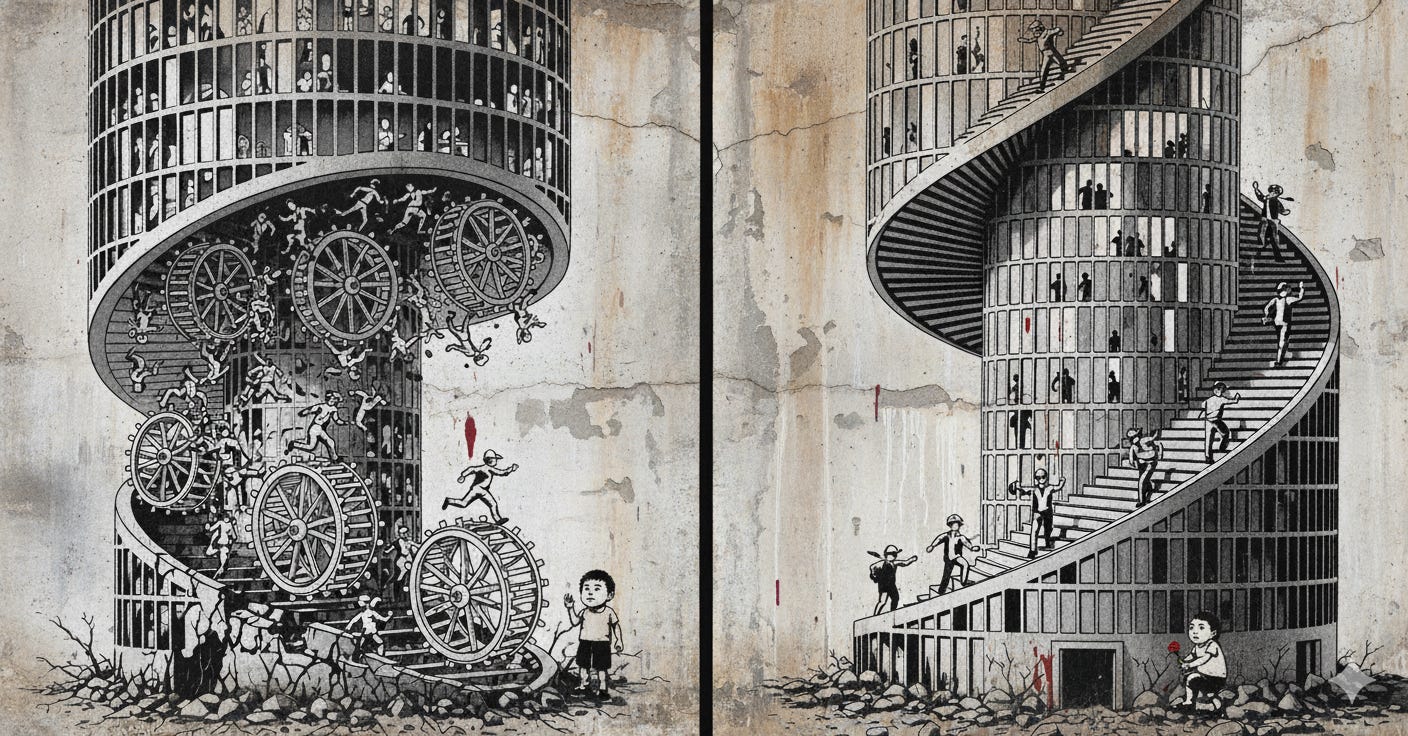
The Descending Spiral
Organizations caught in the reinforcement trap face compounding decline. Each quarter of optimizing for target achievement rather than learning capability makes them less capable of learning in subsequent quarters. They invest heavily in knowledge acquisition—hiring consultants, commissioning research, gathering competitive intelligence—without recognizing that the problem isn’t access to information but capacity to absorb it.
They implement sophisticated knowledge management systems, missing that the issue isn’t knowledge storage but knowledge transformation. They create innovation programs and learning initiatives, failing to see that these programs operate within reinforcement structures that reward theatrical learning over genuine capability development.
Leadership teams grow frustrated that “our people aren’t learning fast enough” or “we’re not innovative enough,” without recognizing that their management systems have been systematically dismantling the organizational capabilities that enable both learning and innovation. The very metrics they use to measure performance prevent them from seeing this dynamic, because those metrics track target achievement rather than absorptive capacity development.
Organizations develop increasingly sophisticated processes for filtering out the very information they most need to absorb. They mistake this filtering for strategic focus, celebrating their ability to “stay on track” even as the track leads somewhere increasingly irrelevant.
The result resembles an immune system that attacks the body it should protect. Their capability deficit compounds, creating a descending spiral that becomes progressively harder to escape. The particularly cruel aspect is that organizations in decline often work harder than those in ascent—but without the underlying absorptive capacity to transform effort into adaptive action, the activity produces exhaustion rather than evolution.
The Ascending Spiral
Meanwhile, organizations with high absorptive capacity enter the opposite dynamic. They don’t just respond faster to individual market signals—they develop increasing capability to recognize, assimilate, and exploit subsequent signals. Each learning cycle doesn’t just produce better immediate results; it builds the organizational muscles that enable even more effective learning in the next cycle.
They enter what might be called an ascending capability spiral, where learning capacity and market performance reinforce each other in a compounding loop.
This explains the puzzling phenomenon of why performance gaps often widen rather than narrow over time. The difference isn’t about working harder or even about having better initial strategy. It’s about whether the organization’s daily operations build or destroy the capacity to learn what matters.
The Transition Challenge
Understanding absorptive capacity as the foundation of organizational learning reveals why transformation is so difficult and why many well-intentioned change efforts fail. Organizations cannot simply decide to “be more learning-oriented” any more than individuals can decide to instantly develop expertise in unfamiliar domains. Absorptive capacity must be built through sustained practice, and that practice requires changing the reinforcement structures that shape daily behavior.
This creates a challenging transition problem. Organizations cannot build absorptive capacity while maintaining systems that destroy it. Yet dismantling those systems without having built the capacity to function differently creates chaos that leadership teams understandably resist. No rational leader will transform their entire organization overnight, nor should they attempt to do so.
The Protected Laboratory
The practical path forward begins not with company-wide mandates but with creating a protected space where laboratory logic can take root and demonstrate its value. This might be a single product initiative, a specific division exploring new markets, or a dedicated team working on emerging opportunities. The key is establishing what might be called an organizational wedge—a strategically significant effort that operates under different rules while the rest of the organization maintains its current approach.
For this protected laboratory to succeed, it must possess three essential characteristics.
First, it must be strategically important, working on genuine business challenges rather than theoretical exercises. Leadership commitment follows from business relevance, not the reverse.
Second, it must be culturally shielded, explicitly protected by senior leadership from the parent organization’s immune system—its quarterly review cycles, rigid resource allocation processes, and traditional performance metrics.
Third, it must be accountable to learning velocity and insight quality rather than predetermined target achievement. Success gets measured by the speed with which the team validates or invalidates hypotheses and translates discoveries into improved approaches.
Building Capability
This protected space serves dual purposes. Most obviously, it tackles meaningful business problems using more effective methods. More importantly, it begins rebuilding organizational muscles that have atrophied under target-oriented management. Teams relearn how to recognize valuable external signals, assimilate disconfirming evidence, transform insights into context-specific approaches, and exploit discoveries through rapid iteration.
The protected laboratory becomes simultaneously a proof point demonstrating superior results and a training ground developing the capabilities the broader organization will eventually need.
This transition demands what might be called meta-learning: organizations must learn how to learn before they can effectively learn what they need to know. They must develop the foundational capabilities—curiosity about disconfirming evidence, comfort with revising mental models, facility with experimental thinking, freedom to exploit discoveries—in a controlled environment before those capabilities can spread throughout the organization and generate the adaptive advantage that justifies the investment.
The encouraging reality is that absorptive capacity, once established, becomes self-reinforcing. Organizations that successfully make this transition discover that learning capability and performance outcomes are not competing priorities but mutually reinforcing dynamics. Teams that focus on understanding what creates value often achieve better traditional metrics than teams that focus solely on hitting predetermined targets, while simultaneously building capabilities that compound over time.

The Strategic Imperative
The absorptive capacity lens reveals why the choice between target-oriented and learning-oriented management is fundamentally about risk, not preference. Target-oriented systems offer something seductive to leadership teams: the appearance of risk mitigation through predictability. Quarterly targets, cascaded objectives, and consistent execution create the comforting illusion that the organization has tamed uncertainty and brought the future under control.
This illusion masks a more profound and existential risk—the risk of perfect execution toward irrelevance. Organizations can hit every target, achieve every key result, and maintain flawless consistency while the ground shifts beneath them. They optimize their operations for an environment that no longer exists, mistaking the absence of internal surprises for the presence of strategic soundness.
This is not risk mitigation; it is risk blindness dressed up as operational excellence.
In stable environments where value creation mechanisms remain constant, target-oriented approaches can indeed optimize execution efficiency. The factory logic that powered industrial success remains appropriate for genuinely predictable work. But in dynamic environments where the basis of competition continuously evolves, absorptive capacity becomes the only reliable form of risk management.
The ability to recognize, assimilate, transform, and exploit new knowledge is not about taking more risks—it is about building the organizational capability to adapt when the environment inevitably changes in ways no planning cycle could predict.
Laboratory logic trades the comfort of short-term predictability for the resilience of long-term adaptation. It acknowledges that in complex, fast-moving domains, the greatest risk is not the discomfort of uncertainty but the certainty of becoming obsolete while looking successful. Organizations that build absorptive capacity are not being reckless; they are being realistic about which risks actually threaten their survival.
The question facing leadership teams is not whether to build absorptive capacity but whether their organizations can survive without it. Organizations that treat this capability as secondary to predictable target achievement are making a bet—that their current understanding of value creation will remain valid long enough to justify ignoring signals that suggest otherwise. In a world where the pace of change continues accelerating, this bet grows increasingly expensive.
The tragedy is that many organizations possess the intelligence, resources, and opportunity to build this capability. What they lack is recognition that their current management systems are destroying it. They celebrate the performance theater of consistent target achievement while the capacity for genuine adaptation erodes beneath them, mistaking operational discipline for strategic resilience.
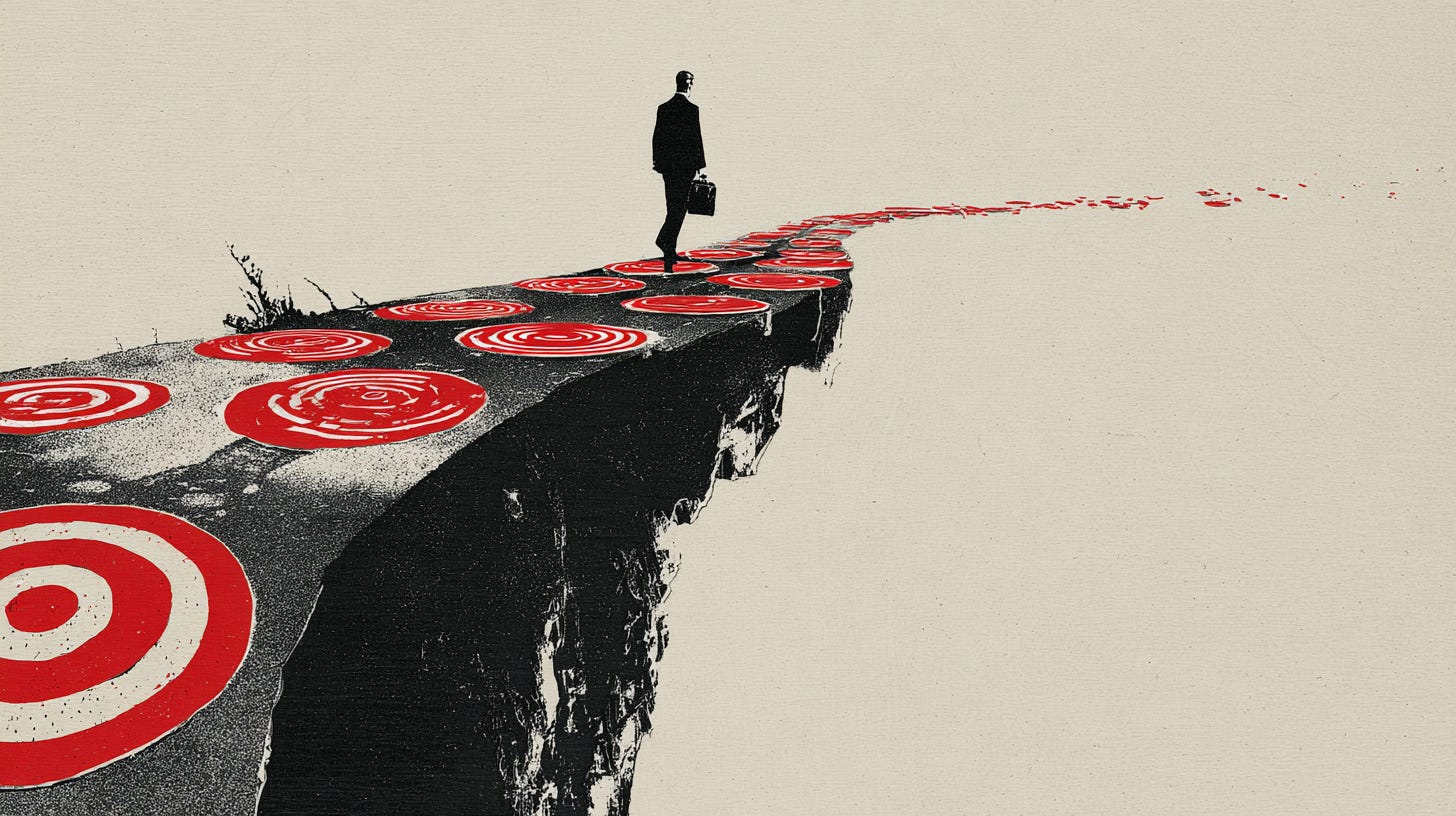
The choice, ultimately, is between two forms of organizational capability. Organizations can optimize for the predictable execution of predetermined plans, accepting the risk that those plans will lead somewhere increasingly irrelevant. Or they can build the capacity for continuous adaptation, accepting the discomfort of uncertainty in exchange for the ability to evolve as their environment evolves.
Organizations cannot maintain both simultaneously. The systems that produce one inevitably undermine the other.
The question is not which approach feels more comfortable, but which capability will prove more valuable in the environment the organization actually faces rather than the one it wishes it faced. In dynamic markets, that answer determines not just competitive position but organizational survival.
For leaders examining whether their organizations build or destroy absorptive capacity, the evidence lies not in strategy documents or stated values but in what gets consistently reinforced through daily responses. When a team’s discovery invalidates their quarterly objective, does the organization respond with increased scrutiny or genuine curiosity about what was learned? When unexpected evidence suggests a better approach, do resources reallocate or do commitments remain locked regardless of new understanding? When teams propose course corrections based on solid evidence, do they receive support to pursue more promising directions or pressure to “stay on track” with original plans?
These patterns—not the ones in your planning documents but the ones revealed through your actual responses to learning—determine whether your organization develops the capacity to adapt or optimizes itself for an environment that no longer exists. The reinforcement structures you maintain today are building the organizational capability you will possess tomorrow. In dynamic markets, that capability gap compounds quickly. The question is not whether to build absorptive capacity, but whether your organization can afford to continue destroying it.
Cohen, W. M., & Levinthal, D. A. (1990). “Absorptive Capacity: A New Perspective on Learning and Innovation.” Administrative Science Quarterly, 35(1), 128-152.
Zahra, S. A., & George, G. (2002). “Absorptive Capacity: A Review, Reconceptualization, and Extension.” Academy of Management Review, 27(2), 185-203.