

Close to the Data, Far from the Decision
Why the people who can read the signal are rarely the ones who can act on it
The signal is there. The platform produces it. The people with the expertise to interpret it correctly are in the building. And the decision gets made anyway, without them, by someone who read the same output and drew a different conclusion.
This is not a data quality failure. It is not a communication failure, though it produces one: when the expert is not in the room, communication travels through documents, and a document cannot defend its own reading. At its root it is a positional failure: the people closest to the meaning of the signal are not positioned where the meaning is applied. Closing that gap is not a technical problem. It is a leadership decision that most organisations have not recognised as a decision at all.

The Signal Without an Interpreter
Every data platform generates signals. Quality gates produce alerts. Governance dashboards surface anomalies. Pipelines raise exceptions.
What a data platform cannot do is interpret. A signal tells you that something has deviated from expectation. It does not tell you whether the deviation is noise or a warning, whether it reflects a genuine problem in the underlying data or a shift in business reality that the expectation was not designed to track. A quality gate firing on 2% of records can mean a pipeline is broken, or it can mean the business definition of a valid record has evolved since the threshold was set. The gate cannot distinguish between these; it can only report the number.
That distinction requires someone who understands both the technical mechanism producing the signal and the business context the signal is trying to protect. In most organisations, that person exists. The problem is not their presence in the building. The problem is their position in the room where the response is decided.
The Gap the Org Chart Produces
The people with genuine interpretive capability: those who understand which signals are real, which are artefactual (false positives produced by the measurement system rather than genuine events), and what the operational consequence of either would be, tend to occupy roles defined around service delivery. They answer questions and respond to requests; they build what others decide to build.
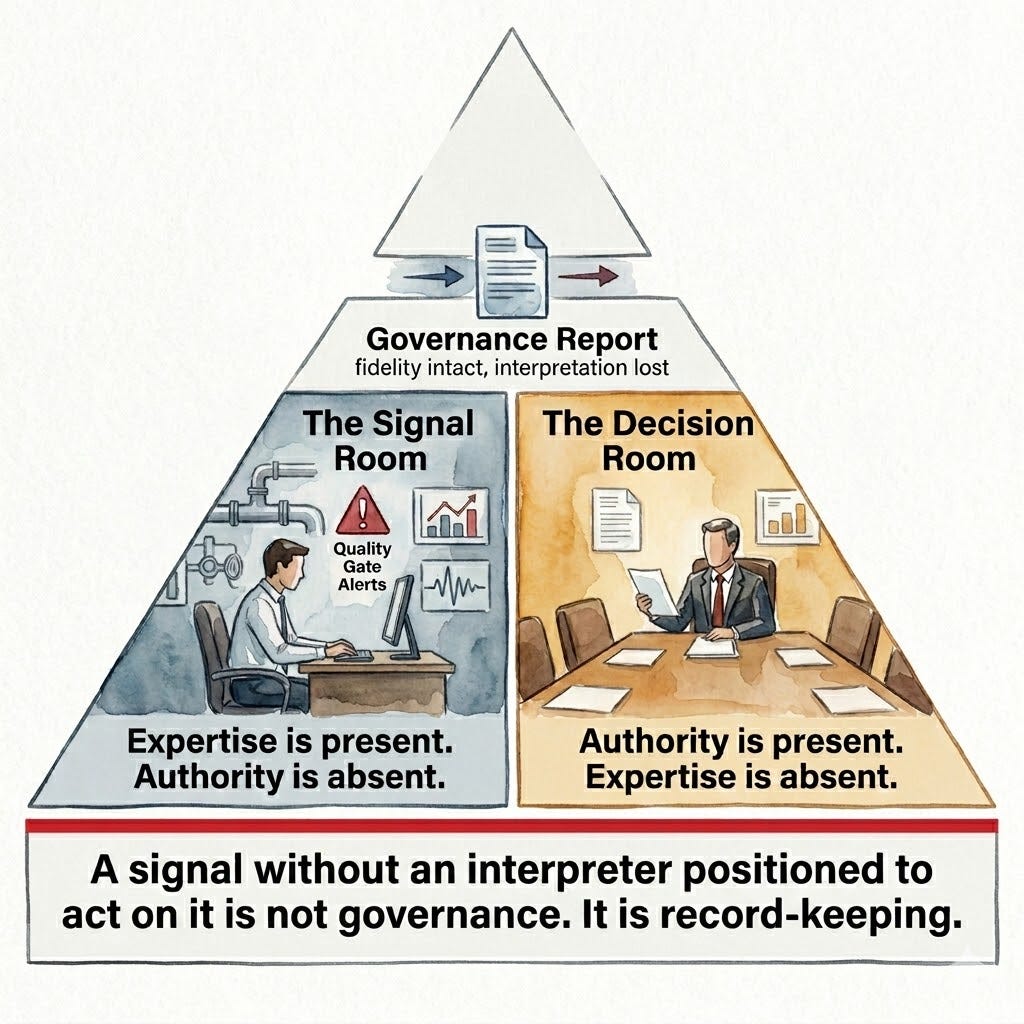
The people who hold authority to act on signals receive governance reports, not signal feeds. They see summaries, not mechanisms. The gap between what the signal says and what the summary communicates widens with every layer of translation, not because communication is failing, but because each translation step moves the signal further from the person who could read it and closer to the person who must act on it.
This is what might be called the interpretation gap: the structural distance between the people who can read the signal and the people who have authority to act on it. When that gap is small, signals drive decisions. When it is wide, signals drive reports that describe what the signal said, which drive meetings that discuss the report, which produce decisions that may or may not reflect what the signal was actually saying.
The interpretation gap is not caused by incompetent leadership or incurious executives. Its root is an organisational design that treats interpretive expertise as a service function rather than a strategic one. But position is not a static fact. Left in place, it does something to the person held in it, and that is where the gap deepens.
The Expertise That Does Not Transfer
The instinct when faced with an interpretation gap is to bring more expertise to bear: better analysts, richer documentation, more detailed reporting.
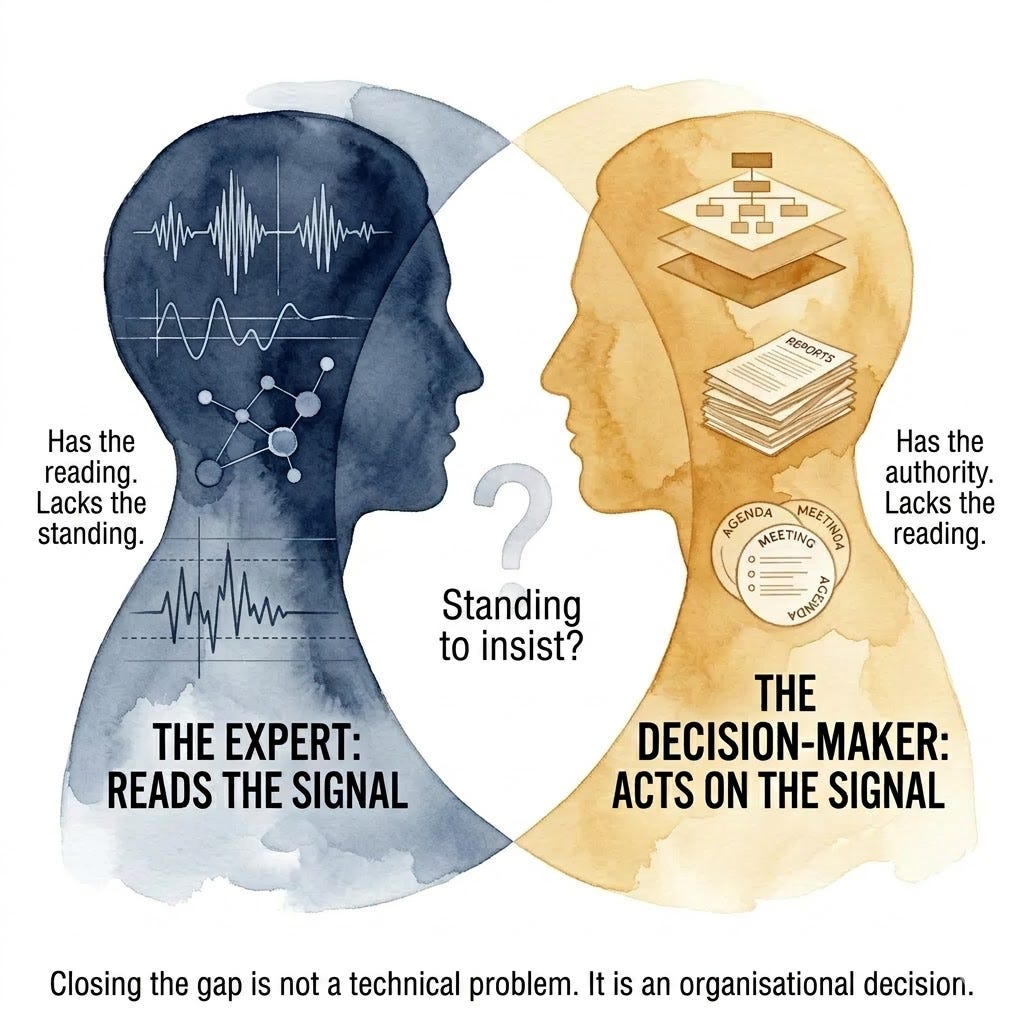
Interpretive expertise and positional authority are not the same resource, and an organisation that treats them as interchangeable will misapply both. The analyst who understands the signal has no authority to act on it unilaterally. The executive who has authority to act may not understand what the signal is measuring, or whether the threshold calibrating it is still tracking the right reality. When the gap between those two positions is filled by documentation, the documentation carries the interpretive weight. And documentation does not argue back when someone reads it wrong.
What the analyst lacks is not knowledge. It is standing: the credibility and position to have a reading taken seriously rather than received as a technical input to someone else’s decision. The people with the most accurate reading of the signal are systematically the ones with the least standing to insist on it.
The Deference the Position Teaches
Standing is not only conferred by the organisation. It is also claimed, or declined, by the person who holds it. An expert positioned in a service function tends to occupy a relationship in which the expected move is to answer rather than to insist, and over time the structure trains that expectation into place. The deference is not a personality trait. It is what the position teaches.
In a governance review, the analyst flags a signal, offers an interpretation, and stops when the response is sceptical. The retreat is not doubt about the reading; it is deference to position: scepticism from someone with authority lands as the question being closed, and pressing past it would feel like exceeding the role. The decision-maker receives the output and moves on. Over time, that exchange becomes the pattern: the expert learns to offer, the decision-maker learns to receive, and each reinforces the other.
The structure positions expertise downstream; the position then teaches the expert to stay there. The gap is held open at both ends, but one end produced the other.
The Room and the Transcript
The interpretation gap closes when interpretive expertise is positioned, not just available. Available means expertise can be accessed when requested. Positioned means expertise is present where decisions are shaped, with enough standing to influence how the signal is read before the response is determined.
Consider how an interpreter works at a negotiation. Sitting in the room, they shape how each side hears the other at the moment the meaning matters. Producing an accurate transcript afterward loses nothing in fidelity and still loses the negotiation, because the room was where interpretation had to land, not the document. A governance report that reaches the leadership team on Monday is the transcript. The analyst whose reading is present in the room on Thursday when the decision is made is the interpreter at the table. The difference is not timing. It is standing: the transcript cannot push back when the room misreads it. The signal is the same in both cases. The interpretation gap is not.
Getting into the room is the easier half. Having the standing to press the reading once there is the harder one.
The Choice No One Remembers Making
Most data platform investments are framed as technical problems with technical solutions. The quality gate, the governance model, the data contract, the observability layer: these are real and important. They determine whether signals are generated and reach the people who need them. What they do not determine is whether those signals are interpreted correctly by people with the standing to act on what they read. That is the positional failure the opening named, and it is not a platform problem.
That is not a platform feature. It is an organisational choice, and one most organisations have made implicitly rather than deliberately.
That architectural default has a history, and understanding it changes what closing the gap requires. In a well-designed product organisation, the person closest to the signal and the person with the mandate to act on it are the same person, or close enough that the gap is small. That is not cultural wisdom. It is architecture: the product model was built on the explicit premise that separating interpretation from decision produces slow, distorted output. The interpretive role and the decision role were collapsed into one position by design. Data organisations inherited a different premise. They grew from centralised analytics and reporting functions whose founding mandate was to serve the business. The separation of interpretation from decision was baked into the structure before anyone thought to question it. Better platforms, richer governance, and more sophisticated tooling have been layered on top, without revisiting the architectural choice underneath. The gap persists not because organisations lack the capability to close it, but because they have not recognised that closing it is a design decision rather than a management one.
When automated systems enter that inherited architecture, the problem does not disappear. It migrates. The interpretation gap moves from the moment of the decision to the moment of design: into the threshold that was set, the rule that was encoded, the contract that was agreed before the signal ever fired. At human speed, a wrong reading can be contested, corrected, pressed past. At machine speed, the encoded judgment executes without the possibility of dissent. The people with the deepest interpretive expertise, the ones this essay has described as positioned downstream, are precisely the people whose judgment gets compressed into a configuration setting and then treated as a technical given rather than a revisable choice. The gap is not closed by automation. It is hidden inside it.
A signal without an interpreter positioned to act on it is not governance. It is record-keeping.
Closing the gap is not a matter of better signals or better readers. It is a matter of where interpretive judgment sits relative to the authority to act, and whether the person who can read the signal has the standing to make their reading count. Most organisations have treated that as a technical question. It was always an organisational one.
This essay connects to a series on the motions that sustain data platforms. "Seeing Everything, Understanding Nothing" develops the legibility trap this essay names: why accurate information fails to produce shared understanding, and what the conditions that prevent that failure require. "A Platform Is Never Finished" sets out the parent framework.
Further Reading
“A Platform Is Never Finished”: the parent framework of exception, presence, and delegation, and why the interpretation gap appears when any one of those motions is missing.
“Seeing Everything, Understanding Nothing”: why data organisations confuse access with understanding, and what closing the gap between visibility and shared interpretation demands.
“Why Semantic Drift Is a Leadership Problem, Not a Technical One”: the same standing problem this essay names, applied to vocabulary rather than signals.
“When Motion Masquerades as Progress”: why measuring platform activity rather than decision quality reinforces the interpretation gap.
Honest Endnote
This essay argues with confidence that the interpretation gap is structural, rooted in organisational design, and widened from both ends by the structure that positions expertise downstream and the expert who learns to stay there.
The open question it cannot resolve is what happens once the position changes. If standing is restored, does the trained deference fade with it, or has it hardened into something that persists on its own? At machine speed the same question sharpens: if the architecture is reformed, does the encoded judgment embedded in existing thresholds get revisited, or does it calcify as a technical given no one remembers choosing?
This essay is a tested version of the argument, not a finished one. The distinction matters because the terrain it describes is one most readers are closer to than the essay is. If you are navigating this and finding something the argument missed, or adjusting it against conditions it did not anticipate, the comments are where that belongs.